When the global pulp and paper industry moves, we report it first — trusted by 11,000+ subscribers across 85 countries

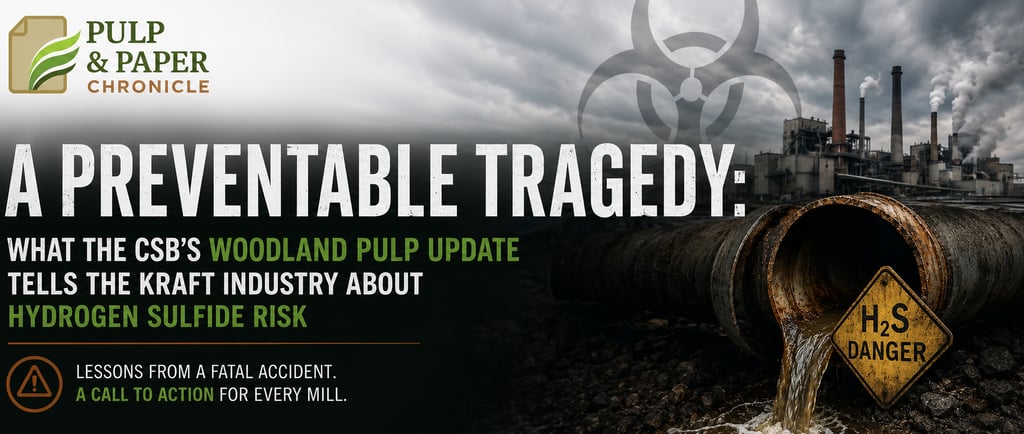
A Preventable Tragedy: What the CSB’s Woodland Pulp Update Tells the Kraft Industry About Hydrogen Sulfide Risk
MARKET ANALYSIS
Jino John
7/17/20263 min read
Every kraft mill should read this.
The U.S. Chemical Safety and Hazard Investigation Board's (CSB) latest update on the January 27, 2026 incident at Woodland Pulp in Baileyville, Maine, is more than an investigation into a tragic accident—it's a reminder that well-understood hazards can become fatal when operating conditions change.
Two young engineers lost their lives due to hydrogen sulfide (H₂S) exposure inside the Kraft Mill building. Ten additional employees were injured.
For an industry built on operational discipline and process safety, this incident deserves careful attention—not only from Woodland Pulp, but from every kraft mill operating today.
Understanding the Chemistry: Why the Acid Sewer Became a Gas Generator
To understand the incident, it helps to understand the role of an acid sewer in a kraft mill.
Within the bleach plant, acidic and alkaline process streams generated during bleaching, washing, and liquor handling are collected and routed through an acid sewer to the wastewater treatment plant.
In Woodland Pulp's system, the sewer extended more than 1,000 feet.
The CSB identified one seemingly simple but critical feature:
An upward transition in the sewer created a location where liquid could accumulate instead of flowing continuously.
That increased residence time became the foundation for everything that followed.
The Chemistry
Kraft mills routinely neutralize wastewater by injecting sulfuric acid into alkaline, sulfur-bearing process streams.
This is standard industry practice.
However, when sulfuric acid reacts with sulfide-containing alkaline streams, hydrogen sulfide gas (H₂S) is produced.
Normally this isn't catastrophic because:
H₂S generation is anticipated.
Bleach plant scrubbers capture the gas.
The hazard is controlled through engineered safeguards.
The chemistry itself wasn't unusual.
The operating conditions became unusual.
How a Routine Shutdown Became a Fatal Event
On January 26, 2026, Woodland Pulp shut down much of the mill because of sharply increasing natural gas prices.
Shutdowns are common throughout the pulp and paper industry.
However, shutdowns also change process conditions dramatically.
As equipment drained during shutdown:
High-pH sulfur-bearing liquids entered the acid sewer differently than during normal operation.
A downstream pH probe detected elevated pH.
The control system automatically increased sulfuric acid addition.
The control loop behaved exactly as designed.
Unfortunately, the liquid had pooled upstream because of the sewer geometry.
The result was continuous acid addition into a stagnant sulfide-rich zone, producing hydrogen sulfide where the monitoring system couldn't detect it.
This is an important process safety lesson:
Sometimes the control system functions correctly while the process assumptions behind it no longer do.
When the Last Safety Barrier Was Removed
Later that morning, the bleach plant scrubber fan was shut down as part of the normal shutdown sequence.
With the scrubber offline:
Hydrogen sulfide could no longer be captured.
Gas migrated through process piping.
It entered process vessels.
It escaped into occupied areas of the Kraft Mill.
The safety system wasn't malfunctioning.
It had simply been taken out of service while the hazardous reaction continued.
This illustrates the importance of evaluating shutdown procedures through a Management of Change (MOC) perspective—not just normal operations.
Three Missing Layers of Protection
The CSB identified several critical gaps that significantly increased the severity of the incident.
1. Personnel Accountability
The mill had no effective system to determine who remained inside the building during the shutdown.
2. Building Ventilation
The Kraft Mill building lacked ventilation capable of removing hazardous gas during abnormal operating conditions.
3. Hydrogen Sulfide Detection
The building had:
No fixed H₂S detectors
No H₂S alarms
No required personal H₂S monitors
As a result, two engineers remained undiscovered for hours after the release had dissipated.
Why This Matters Beyond Woodland Pulp
This wasn't an obscure or unique process hazard.
Many kraft mills operate with:
Acid sewer neutralization systems
Sulfur-bearing process streams
Downstream pH-controlled acid addition
Bleach plant scrubbers
Routine shutdown procedures
What made Woodland different wasn't unusual chemistry.
It was the combination of several ordinary conditions occurring simultaneously:
An economically driven shutdown
Changed hydraulic flow
A downstream-only control strategy
A scrubber taken offline
Limited H₂S monitoring
No personnel accountability
Individually, each condition might have been manageable.
Together, they became fatal.
What Mills Should Review Now
While the CSB investigation continues, the preliminary update already highlights several areas worth reviewing across the industry:
Personnel accountability during startups and shutdowns
Management of Change (MOC) reviews for shutdown procedures
Additional pH monitoring closer to reaction zones
Fixed hydrogen sulfide detection
Personal H₂S monitors for exposed personnel
Ventilation strategies during abnormal operating conditions
Review of acid sewer hydraulics and accumulation points
These are practical engineering reviews that can be undertaken before the final investigation report is released.
Final Thoughts
The pulp and paper industry has made tremendous progress in process safety over the past several decades.
Yet incidents like Woodland Pulp remind us that hazards don't disappear simply because they have been managed successfully for years.
Process conditions change.
Shutdowns introduce new operating states.
Safety systems designed for steady-state operation may not provide the same protection during transient events.
The Woodland Pulp incident is a reminder that process safety depends not only on understanding chemistry, but also on understanding how systems behave when operations change.