When the global pulp and paper industry moves, we report it first — trusted by 10000 subscribers across 85 countries

Aragon Leads Spain's Paper Industry
PAPER INDUSTRY NEWS
Jino John
1/26/20262 min read
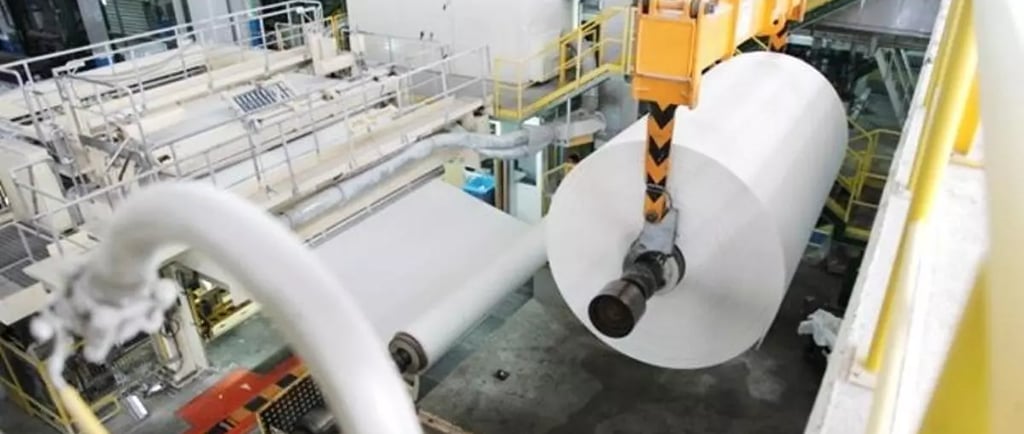
Aragon has established itself as one of Spain's leading paper and cardboard manufacturing hubs, a long-standing specialization that has made it a true epicenter of the sector. From complex integrated pulp, paper, and cardboard plants to cutting-edge recycling and circular economy facilities, the autonomous community accounts for around 34% of national production , a prominence that explains why this sector remains one of the most discreet, yet also most solid, pillars of the Aragonese economy.
Large companies like Saica , Tronchetti , DS Smith , and Lecta have transformed Aragon into a key region for an industry that combines volume, technology, and exports. It's no coincidence that one out of every three kilograms of paper that Spain exports—32.7%—comes from Aragonese factories, according to data from the Spanish Tax Agency .
The Spanish pulp, paper, and cardboard industry reached a turnover of €5.232 billion , according to data from the end of 2024 (the latest year available), just 0.6% less than the previous year. This occurred in a context marked by rising energy costs and higher structural costs than in competing countries, as explained by Aspapel, the Spanish trade association for this sector. The slight drop in sales contrasts with the growth in production, which rose 8.5% in paper and cardboard and 5.3% in pulp , indicating that the industrial sector remains strong.
This productive activity also translates into stable, skilled employment . The sector directly employs 17,500 people in Spain and generates nearly 87,000 indirect jobs. In Aragon, there are eight production centers operated by seven companies that support almost 1,900 jobs, representing 11% of the paper industry's employment nationwide—a proportion far exceeding the region's population.
Exporting from Aragon
Paper from Aragon is primarily exported to Europe . In 2024, Spanish paper and cardboard exports grew by 17.9%, reaching 2.89 million tons, equivalent to 44% of total national production. Portugal, France, Italy, the Netherlands, and Germany account for the majority of these shipments, a pattern also observed in Aragon.
In the case of pulp, more than half of Spanish production—58.6%—is destined for foreign markets , with the European Union playing a particularly significant role . Spain is currently the sixth largest producer of paper and cardboard in the EU and the fifth largest producer of pulp, positions that reinforce the strategic importance of the sector.
The United States ' trade policy has little direct impact on Spanish paper mills. Only 2.7% of the sector's exports are destined for that country. However, the industry association Aspapel warns of a risk that is more difficult to measure: the rebound effect. Products from third countries, which were previously focused on the US market and now face tariffs, are being redirected towards Europe, increasing competition in traditional markets.
"A coordinated European response is essential, with swift measures to avoid distortions," says Manuel Domínguez, CEO of Aspapel, who calls for negotiation , international cooperation and strengthening of the single market.
If there's one area where the Spanish paper industry – and especially that of Aragon – has a clear advantage, it's sustainability. In 2024, the factories recycled 5.5 million tons of paper, achieving a recycling rate of 83.6% , the third highest in the European Union.
“Sustainability is a driver of growth,” he emphasizes. “We continue to focus on circularity, improving production processes, and decarbonization. The combination of innovation and sustainability will allow us to further consolidate our position as a benchmark in Europe ,” he notes.