When the global pulp and paper industry moves, we report it first — trusted by 10000 subscribers across 85 countries
Christmas Wrapping Paper Recycling Rules Reveal a Global Sustainability Blind Spot
MARKET ANALYSIS
Jino John
12/27/20252 min read
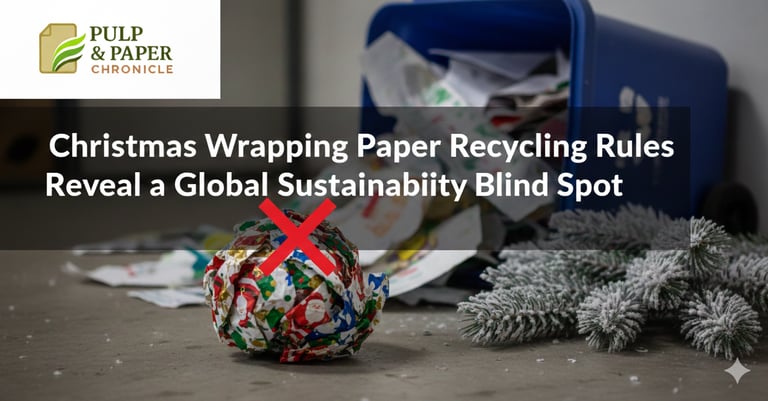
Every festive season, the same question resurfaces across households worldwide: Can Christmas wrapping paper be recycled?
What appears to be a minor seasonal concern has, in reality, become a clear indicator of a much larger issue — the gap between sustainability ambition, system design, and everyday consumer behaviour.
A Seasonal Spike with System-Wide Impact
The holiday period drives a sharp increase in household waste globally. Wrapping paper, while symbolic of celebration, represents a disproportionate challenge for recycling systems.
Much of it:
Contains plastic coatings, foil, or metallic finishes
Is laminated or heavily treated with dyes and adhesives
Cannot be processed through standard paper recycling streams
When incorrectly recycled, these materials contaminate collections, reduce material quality, and increase operational costs across waste management systems — regardless of geography.
Confusion Is a System Failure, Not a Consumer Failure
Across regions, recycling guidance varies widely between municipalities, service providers, and countries. For consumers, this inconsistency creates confusion. For waste operators, it leads to contamination. For sustainability goals, it results in lost value.
This is not a communication issue alone — it is a system design challenge.
Clear, consistent, and accessible information is essential if recycling systems are expected to perform at scale, particularly during high-consumption periods like the holidays.
Shared Responsibility Across the Value Chain
The annual debate around wrapping paper recycling highlights a fundamental truth: sustainability cannot rest on consumer behaviour alone.
Governments and regulators must work toward clearer, more harmonised guidance.
Manufacturers and retailers must reduce non-recyclable decorative materials and improve on-pack labelling.
Waste management leaders must anticipate seasonal surges and design systems that are resilient under pressure.
Consumers need simple, trustworthy information that enables correct decisions at the point of disposal.
When people are confused, the system — not the individual — is what needs to evolve.
Why This Matters Beyond the Holidays
While wrapping paper may seem trivial, it is emblematic of a wider sustainability challenge: materials designed for short-term use but long-term impact.
Left unaddressed, these issues:
Undermine public confidence in recycling systems
Increase costs across supply and waste chains
Slow progress toward circular economy and net-zero targets
Conversely, solving them strengthens trust, efficiency, and environmental outcomes.
Turning a Seasonal Debate into Global Progress
Rather than revisiting the same discussion every December, the global sustainability community has an opportunity to treat this as a case study in better design, clearer policy, and stronger collaboration.
The real question is not whether wrapping paper is recyclable.
The question is whether our systems are built for clarity, scale, and long-term sustainability.