When the global pulp and paper industry moves, we report it first — trusted by 10000 subscribers across 85 countries
Europe’s Paper Industry at a Breaking Point: Energy and Carbon Costs Threaten a Strategic Sector
MARKET ANALYSIS
Jino John
2/13/20263 min read
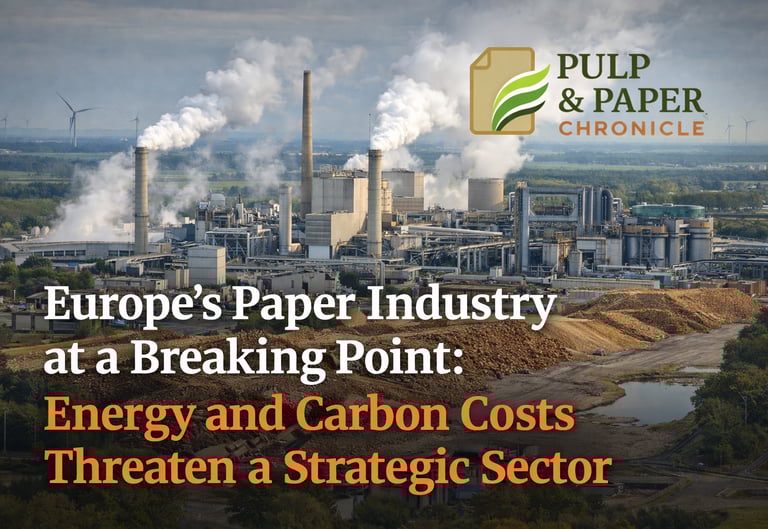
Europe’s paper and pulp industry stands at the frontline of the continent’s industrial and climate transition. As highlighted in the Energy-Intensive Industries Joint Statement on Energy and Carbon Costs (February 2026), the paper sector is increasingly exposed to structural cost pressures that risk accelerating plant closures, investment leakage, and long-term deindustrialisation.
Represented at EU level by organisations such as Confederation of European Paper Industries (CEPI), the sector is a cornerstone of Europe’s circular bio-economy — supplying packaging, hygiene products, graphic paper, and advanced fibre-based materials essential to food security, healthcare, logistics, and renewable alternatives to plastics.
Yet today, Europe’s paper industry is struggling to reconcile global competitiveness, energy affordability, and climate ambition.
An Energy-Intensive but Climate-Positive Industry
Paper manufacturing is inherently energy-intensive. Large volumes of electricity and heat are required for pulping, drying, and finishing processes. While the industry has already made major strides — including high recycling rates and extensive use of biomass-based energy — it remains acutely vulnerable to:
Persistently high electricity prices
Rising natural gas and network costs
Escalating EU ETS carbon prices
According to the joint industry statement, current energy prices in Europe remain structurally higher than in competing regions such as North America and parts of Asia. For paper producers operating on tight margins, this difference is often decisive when determining whether to modernise a mill — or shut it down.
Carbon Costs: Decarbonisation Without the Means to Decarbonise
The paper industry strongly supports Europe’s climate objectives. However, the statement warns that carbon costs are rising faster than viable decarbonisation solutions.
Key concerns for paper producers include:
EU ETS allowance prices that have multiplied compared to pre-2020 levels
Progressive reductions in free allocation benchmarks, even where no large-scale alternatives exist
Limited access to affordable low-carbon electricity and infrastructure
Without reliable access to competitively priced clean energy, higher carbon prices act less as an incentive and more as a penalty for remaining in Europe. The result is investment delay — or relocation — rather than faster decarbonisation.
For paper mills, many of which are located in rural or industrial transition regions, this directly threatens local employment and regional cohesion.
Trade Exposure: Competing With Imports That Don’t Play by EU Rules
The European paper industry operates under some of the strictest environmental and social standards in the world. Yet imported paper and packaging products often face:
Lower or no carbon pricing
State-subsidised energy costs
Weaker environmental enforcement
The joint statement stresses that without stronger EU trade defence instruments, European paper producers are exposed to unfair competition — especially in packaging grades, graphic papers, and converted products.
While mechanisms like CBAM are under development, they do not yet fully cover all paper products or downstream value chains, leaving European producers at a structural disadvantage.
Demand Matters: Rewarding Low-Carbon European Paper
One of the paper industry’s strongest messages aligns with the joint statement’s call to boost demand for “products proudly made in Europe.”
European paper is:
Highly recyclable and renewable
Produced under transparent sustainability rules
Often significantly lower-carbon than imported alternatives
Yet public procurement and private purchasing decisions frequently prioritise short-term price over long-term environmental value.
The industry therefore supports:
Green public procurement favouring EU-produced, low-carbon paper
Clear origin and sustainability transparency in supply chains
Market recognition for circular, fibre-based solutions over fossil-based alternatives
Creating demand certainty is essential to justify the large-scale investments needed to modernise mills and electrify processes.
What the Paper Industry Is Asking For
In line with the Energy-Intensive Industries Joint Statement, Europe’s paper sector is calling on policymakers to:
Lower total energy costs by reducing levies, network charges, and taxes on industrial electricity
Stabilise carbon costs in 2026, avoiding further ETS tightening until enabling conditions exist
Ensure fair trade, with effective protection against subsidised and high-carbon imports
Create markets for sustainable European paper, through procurement and demand-side policies
These measures are not about weakening climate ambition — they are about making decarbonisation economically viable inside Europe.
Conclusion: A Circular Champion at Risk
The European paper industry is one of the EU’s quiet climate success stories: renewable raw materials, world-leading recycling rates, and a central role in replacing fossil-based products. But as the joint industry statement makes clear, even the most sustainable sectors cannot survive structural energy and carbon cost disadvantages.
If Europe wants a resilient, circular, and climate-neutral economy, it must ensure that paper mills — and the communities they support — can continue to operate, invest, and innovate on European soil.
The choice facing policymakers is stark: enable competitive decarbonisation — or manage irreversible deindustrialisation.