When the global pulp and paper industry moves, we report it first — trusted by 10000 subscribers across 85 countries

Global Paper & Packaging Sector —Weekly Earnings Review
PAPER INDUSTRY NEWS
Jino John
5/23/20263 min read


Executive Summary
Key Themes This Week
Indian paper demand appears to be stabilizing after multiple weak quarters.
Packaging and paperboards are outperforming commodity pulp businesses.
Margin recovery is uneven and still vulnerable to imported low-cost paper.
European and Japanese producers remain under pressure from energy, freight, and weak pulp cycles.
Companies with integrated forestry assets and diversified packaging exposure are proving more resilient.
Company-by-Company Analysis
JK Paper
Financial Highlights
JK Paper reported a strong Q4 FY26 recovery supported by higher sales volumes and improved realizations. Consolidated turnover reached approximately ₹2,111 crore, while EBITDA improved to about ₹279 crore. Profitability rebounded sharply versus the weak FY25 base.
What Drove Performance
Record core paper volumes helped absorb fixed costs.
Copier and packaging board demand improved sequentially.
Better operating leverage supported EBITDA expansion.
Cost pressures moderated compared with earlier quarters.
Strategic Signals
Management appears focused on:
premium paper mix,
packaging board expansion,
and operational efficiency.
The company also maintained shareholder returns through a ₹4 dividend recommendation.
Risks
Imported paper from Asia remains a pricing threat.
Wood and pulp cost inflation could reappear quickly.
Industry capacity additions may pressure realizations in FY27.
Outlook
JK Paper looks positioned for cyclical recovery if domestic demand continues improving and imports remain manageable.
Chuetsu Pulp & Paper
Financial Highlights
Chuetsu Pulp & Paper reported lower FY2025 operating profit amid:
weak overseas pulp markets,
higher distribution costs,
and softer domestic demand conditions.
What Hurt Performance
Export pulp pricing remained weak.
Freight and logistics costs rose materially.
Domestic paper consumption in Japan stayed sluggish.
Currency and energy volatility pressured margins.
Strategic Signals
The results reinforce how vulnerable commodity pulp producers remain in the current cycle. The company’s exposure to global pulp pricing limited pricing power.
Risks
Continued weakness in Chinese pulp demand.
Global oversupply in commodity pulp markets.
Persistent energy inflation in Japan.
Outlook
Near-term recovery depends heavily on:
global pulp price normalization,
freight stabilization,
and Asian demand recovery.
Among the companies reviewed this week, Chuetsu appears the most operationally pressured.
Altri
Financial Highlights
Altri emphasized resilience despite severe weather disruptions affecting operations during the quarter. The company signaled expectations for gradual recovery as operational conditions normalize.
Key Takeaways
Climate-related operational disruptions are becoming financially material for pulp producers.
Despite temporary production impacts, management emphasized resilience and recovery capability.
Integrated forestry assets likely helped mitigate supply shocks.
Strategic Signals
Altri’s messaging focused on:
operational continuity,
sustainability,
and long-term recovery confidence.
This reflects a broader trend where ESG-linked resilience and forestry management are becoming strategic advantages.
Risks
Climate volatility and wildfire risk in Europe.
Continued pulp-market weakness.
Energy price instability.
Outlook
Altri may recover operationally faster than pure commodity peers because of:
vertical integration,
forestry access,
and disciplined balance-sheet management.
ITC Limited — Paperboards, Paper & Packaging Segment
Financial Highlights
ITC’s Paperboards, Paper & Packaging (PSPD) business delivered a strong sequential recovery in Q4 FY26 after prolonged weakness. The broader company also surprised positively on operating margins.
What Improved
Better packaging demand recovery.
Improved operating efficiencies.
Stabilization in input costs.
Stronger premium packaging demand.
Structural Strengths
ITC benefits from:
integrated pulp and packaging operations,
captive demand from FMCG businesses,
and leadership in sustainable packaging.
Its sustainable packaging investments continue gaining strategic importance.
Risks
Cheap imports still pressure domestic pricing.
Packaging demand remains tied to FMCG consumption trends.
Competition from regional players persists.
Outlook
ITC’s PSPD business may be entering an early-stage earnings recovery cycle, especially if:
FMCG demand strengthens,
premium packaging grows,
and sustainable alternatives gain market share.
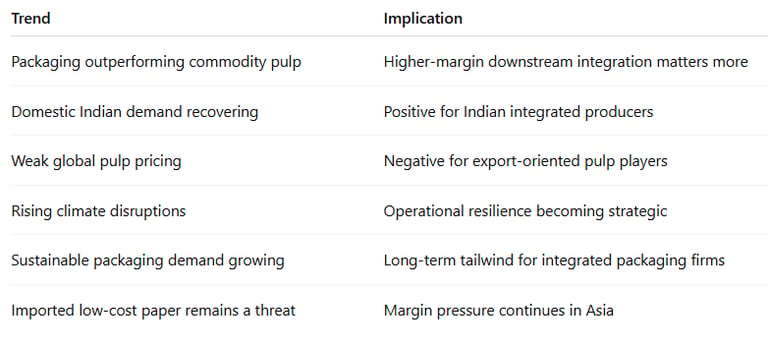
Cross-Sector Trends Emerging This Week
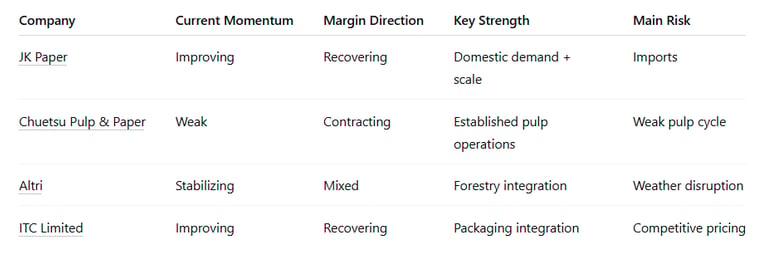
Comparative Positioning
Investor Interpretation
Bullish Signals
Indian paper cycle may have bottomed.
Packaging demand is healthier than commodity printing paper.
Integrated business models are outperforming standalone pulp producers.
Sustainable packaging remains a structural growth theme.
Bearish Signals
Commodity pulp markets remain weak globally.
Import pressure continues hurting pricing discipline.
Freight, energy, and climate risks remain elevated.
Recovery remains volume-led rather than pricing-led.
Sector View Going Forward
Most Resilient Business Models
Integrated packaging + paper companies
Forestry-backed pulp producers
Companies with captive demand ecosystems
Most Vulnerable
Commodity pulp exporters
Firms dependent on spot pulp pricing
Producers exposed heavily to imported paper competition
Overall Weekly Conclusion
This week’s earnings reinforce that the paper industry is splitting into two distinct groups:
Integrated packaging-led companies are beginning to recover with improving margins and stronger domestic demand.
Commodity pulp-heavy businesses remain trapped in a weak pricing environment with cost inflation pressures.