When the global pulp and paper industry moves, we report it first — trusted by 10000 subscribers across 85 countries

How The Union Budget 2026 Will Affect India’s Pulp & Paper Industry — Practical Takeaways for Producers, Converters and Recycler
MARKET ANALYSIS
Jino John
2/1/20264 min read
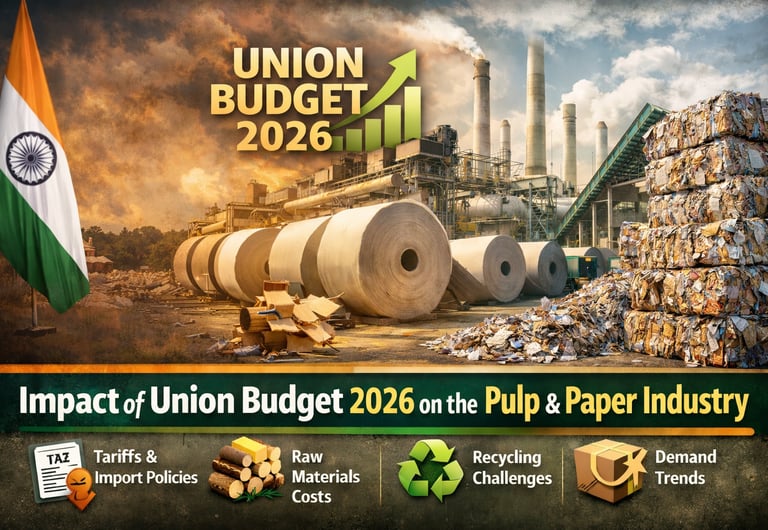
The Union Budget presented on 1 February 2026 contains several measures that materially touch the pulp, paper, packaging and recycling segments. Key near-term effects are:
Targeted customs / import measures — amendments and deadlines in the Finance Bill create temporary exemptions and clarifications for inputs used in paper manufacture (notably pulp, wastepaper imports and certain coated/lightweight papers) that will shape raw-material sourcing and costs.
Trade-management & anti-dumping controls remain active — recent Minimum Import Price (MIP) actions and the government’s commitment to strengthening customs warehousing and digital cargo clearance will continue to influence import economics and inventory strategies.
Demand drivers: budget emphasis on manufacturing, MSME support, packaging-led growth and city redevelopment funds implies continued demand for packaging board and specialty papers. Independent analysis firms and industry bodies expect steady volume growth for paperboard and packaging.
Circular-economy signals: stakeholders pushed for easier scrap/waste imports and tariff rationalisation; the Budget’s discussion on trade simplification and recycling underscores policy attention but concrete tariff relief for scrap was not universally delivered in headline measures.
Below is a practical, section-by-section analysis you can adapt into a full feature for Pulp and Paper Chronicle.
1) Raw materials & trade policy — immediate operational impacts
What the Budget changed (or clarified)
The Finance Bill accompanying Budget 2026 includes amendments that explicitly address goods imported for use in the manufacture of paper, paperboard and newsprint — including timelines for specified exemptions and conditions (references and sunset dates are included in the Bill excerpts). That creates short-to-medium term certainty for some import categories while leaving room for future policy tweaks.
Why it matters to mills & converters
Pulp & wastepaper sourcing: temporary duty exemptions or specially worded clauses can lower landed costs for producers relying on imported wood pulp or wastepaper. But these are typically subject to notified conditions (actual-user clauses, MIPs or anti-dumping safeguards). Procurement teams should verify HS codes and any actual-user registration requirements immediately.
Price floor / MIP: earlier MIP notifications on certain paperboards (e.g., virgin multi-layer paperboard) continue to influence competitiveness of imported grades; if MIPs are extended or repeated, local mills may retain price advantages in those segments.
Recommended actions for industry
Reconcile your import HS codes and inward supply contracts with the Finance Bill’s listed items. If your mill uses imported pulp/wastepaper, secure proof-of-use documentation and check whether your imports qualify for any specified exemptions.
2) Customs warehousing, logistics & ease-of-doing-trade
Budget measures to watch
The Budget emphasised transforming the customs warehousing framework to a more operator-centric model with self-declarations, electronic tracking and risk-based audits; and a digital single window for cargo clearances by year-end. These process reforms aim to reduce clearance lead times and compliance friction.
Impact on the sector
Faster customs clearance and more flexible warehousing can lower working capital tied up in imported raw material pipelines — beneficial for mills that import seasonally or use extended warehousing to manage pulp supplies.
Risk-based audits and self-declaration will place more emphasis on robust ERP / traceability systems for actual-user claims and inventory tracking.
Industry checklist
Accelerate digitalisation of import documentation and inventory traceability.
Engage with port/warehouse operators to understand pilot schemes for the new operator-centric warehousing model.
3) Demand outlook — packaging, MSMEs and infrastructure spend
Budget signal
The Budget’s push for manufacturing, urban redevelopment (Urban Challenge Fund) and MSME support is expected to sustain packaging demand — particularly paperboard for FMCG, e-commerce, pharma and food packaging. Independent industry analyses anticipate continued volume growth in paperboard segments.
How segments fare
Paperboard / packaging: biggest near-term beneficiary — capacity utilisation gains likely.
WPP / writing & printing: mixed — digitisation trends still weigh on demand but education and publishing pockets remain stable.
Specialty papers: luxury packaging and specialty grades could benefit from export promotion and higher domestic brand packaging spends.
Commercial advice
Prioritise conversion capacity expansion and product mix tilt towards packaging board where margins and demand visibility are stronger.
Partner with FMCG customers to co-design sustainable packaging solutions, leveraging budget signals on circular economy/sustainability.
4) Recycling & circular economy — policy momentum but incomplete answers
What industry asked for
Recyclers and paper-sector stakeholders had publicly called for facilitation of scrap imports (zero duty on scrap) and tariff rationalisation to support the circular economy and lower raw-material costs. The Budget’s discussion on trade simplification and recycling shows receptivity, but specific tariff relief for all scrap categories was not rolled out as a universal measure in the headline documents.
Practical effect
Where MIPs, safeguards or selective duty lines remain, recyclers may face constrained feedstock flows or premium pricing for certain grades.
Opportunity: convertors and mills that invest in domestically-sourced recycled furnish may gain from policy nudges (state-level support for agroforestry, municipal waste programmes, etc.).
What recyclers should do
Map the exact HTS/ITC codes used in your supply chain and lobby through trade bodies for clear inclusion/exclusion in any future scrap-duty rationalisation.
Explore backward integration or local collection programmes to reduce reliance on imported scrap vulnerable to policy shifts.
5) Taxation, incentive schemes & financing
Budget highlights relevant to industry
The Finance Bill and budget documents include proposals aimed at simplifying customs administration and enabling manufacturing competitiveness; there’s also a wider push for startup incentives, deep-tech funds and MSME support that packaging SMEs could tap.
Implication
Short-term tax rates for corporates were not radically altered in headline measures, but several procedural and administrative changes (customs, warehousing, digital windows) reduce indirect costs.
Producers should evaluate whether capital expenditures for conversion lines or green upgrades are eligible for any new incentive windows or concessional credit lines announced in the Budget instruments.
Recommendation
Run a short “Budget impact RAR” (Regulatory, Accounting, Risk) on planned capex and refinancing to claim any eligible incentives or concessions; engage tax advisors on interpreting Finance Bill clauses for actual-user and import-duty exceptions.
6) Sustainability & energy — green transition signals
The Budget continues to favour green manufacturing and critical minerals (for other sectors), and hinted at finance for sustainability-linked projects. For the paper sector — energy efficiency, effluent treatment and renewable energy adoption — there will be both regulatory pressure and financing windows (central/state) to modernise mills. Firms that modernise pulp bleaching, water-use efficiency and co-generation stand to gain working-cost and compliance advantages.
7) Risk factors & watchlist (next 6–18 months)
Sunset clauses and notification windows in the Finance Bill mean some import exemptions are temporary — track official notifications.
Potential extension of MIP or safeguard measures (e.g., on board grades) could re-shape import economics unexpectedly.
GST / indirect tax rationalisation remains an ongoing process — any future GST slab changes for paper products would materially affect margins; monitor GST 2.0 discussions.
Practical takeaways for Pulp & Paper Chronicle readers (actionable bullets)
Immediate (0–3 months): Audit import HS codes and actual-user compliance; verify stock levels against potential policy renewals.
Short term (3–9 months): Prioritise packaging board and conversion investments to capture demand uplift from manufacturing & urban redevelopment spend.
Medium term (9–18 months): Accelerate recycling-feedstock programmes and engage trade bodies to press for scrap tariff liberalisation.
Ongoing: Digitise customs and inventory processes to benefit from the operator-centric warehousing model and single-window cargo clearance