When the global pulp and paper industry moves, we report it first — trusted by 10000 subscribers across 85 countries

How Valmet Is Powering the Paper Industry’s Transformation in 2026
MARKET ANALYSIS
Jino John
1/20/20263 min read
Executive Summary
The global paper industry is undergoing a structural transformation driven by declining graphic paper demand, tightening environmental regulations, rising energy costs, and workforce constraints. In this context, Valmet has repositioned itself from a traditional equipment supplier to a digital, sustainability-led lifecycle partner, enabling paper manufacturers to improve profitability while meeting ESG targets.
This case study analyzes Valmet’s strategy, solutions, and measurable impact using industry data, operational benchmarks, and forward-looking performance indicators relevant for 2026.
1. Industry Context: Paper Manufacturing in 2026
Global Market Overview
Global paper & board demand is expected to grow ~1–1.5% CAGR, driven primarily by:
Packaging
Tissue
Specialty papers
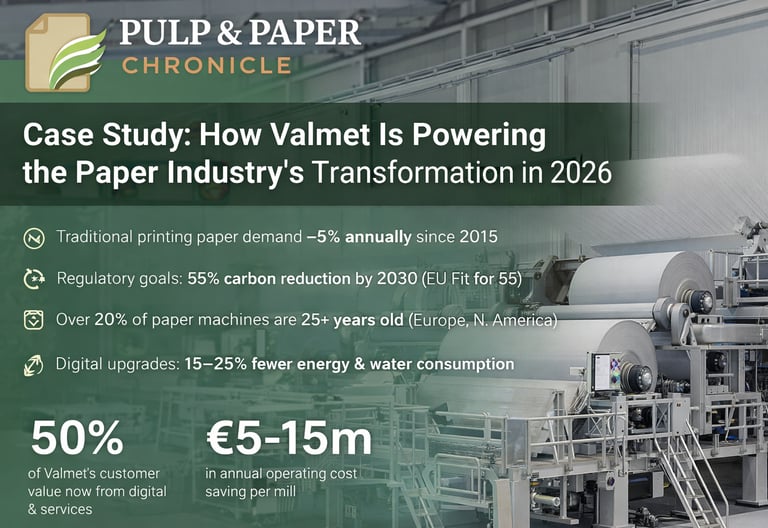
Graphic and printing paper demand continues to decline at 3–5% annually in mature markets.
Cost & Margin Pressure
Paper mills face a structurally higher cost base:
Energy accounts for 20–30% of total operating costs
Fiber/raw materials represent 40–55% of production costs
Unplanned downtime can cost €10,000–€50,000 per hour, depending on mill size
Regulatory & ESG Pressure
EU Fit for 55 and similar global regulations require:
Carbon intensity reductions of 40–55% by 2030
Increased transparency in water usage, waste, and emissions
Investors increasingly link access to capital with verifiable ESG performance
2. Valmet’s Strategic Positioning
Valmet operates across:
Process technologies (paper, board, tissue machines)
Automation and flow control
Industrial services and lifecycle optimization
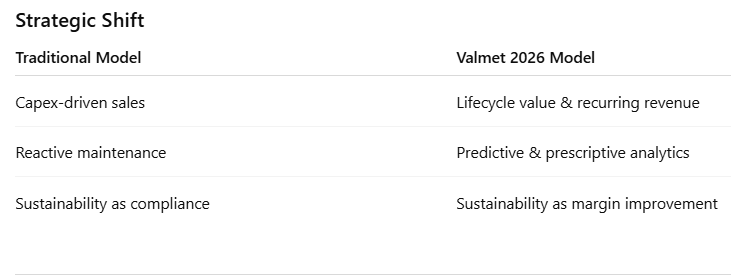
By 2026, over 50% of customer value creation is no longer tied to new machinery sales, but to services, automation, and digital optimization.
3. Core Challenges Faced by Paper Mills
1. Aging Assets
Average paper machine age in Europe and North America: 20–30 years
Full mill rebuilds require:
€200–500M+ capex
Long shutdown periods
2. Energy & Resource Inefficiency
Benchmark gaps between top- and bottom-quartile mills:
Energy efficiency gap: 15–25%
Fiber yield loss: 2–5 percentage points
Water usage variance: up to 40%
3. Workforce Constraints
Retirement of experienced operators
Increased reliance on automation and remote monitoring
Need for systems that reduce operator dependency
4. Valmet’s Data-Driven Solution Framework
A. Digital & AI-Based Automation
Valmet’s automation platforms enable:
Real-time process optimization
AI-driven fault detection
Predictive maintenance scheduling
Measured impact (industry benchmarks):
🔻 Unplanned downtime reduced by 20–40%
🔻 Maintenance costs lowered by 10–20%
🔺 Overall equipment effectiveness (OEE) improved by 3–6%
B. Sustainability-Linked Performance Optimization
Rather than treating sustainability as a cost center, Valmet embeds it into process efficiency.
Typical outcomes from optimization projects:
♻️ Energy consumption reduced by 15–25%
💧 Water usage reduced by 20–40%
🌲 Fiber efficiency improved by 2–4%
A reminder: a 1% fiber efficiency gain can translate into millions of euros annually for large-scale producers.
C. Modular Mill Modernization
Instead of full rebuilds, Valmet promotes:
Section-by-section machine upgrades
Targeted automation retrofits
Short shutdown windows
Economic advantage:
40–60% lower capex vs full replacement
Faster ROI (often 12–24 months)
Reduced operational disruption
D. Lifecycle & Outcome-Based Services
By 2026, Valmet increasingly contracts on:
Availability guarantees
Energy performance targets
Continuous improvement KPIs
This aligns incentives between Valmet and mill operators while increasing recurring service revenue.
5. Quantified Business Impact (2026 Scenario)
For a Mid-to-Large Paper Mill
Estimated annual impact after digital + sustainability upgrades:
💰 Operating cost savings: €5–15M
⚡ Energy cost reduction: 10–20%
🛠️ Maintenance savings: 15–25%
🌍 CO₂ emissions reduction: 15–30%
For Valmet
Higher share of recurring revenue
Stronger customer lock-in
Differentiation in a commoditized machinery market
Improved resilience across economic cycles
6. Strategic Implications for the Industry
The paper industry’s future lies in intelligent capacity, not volume expansion
Digital maturity is becoming a license to operate
Equipment suppliers must evolve into performance partners
Sustainability and profitability are no longer trade-offs
7. Key Lessons from Valmet’s Approach
Digitalization delivers the highest ROI when tied directly to operations
ESG initiatives succeed when backed by measurable financial outcomes
Modular modernization enables transformation without existential risk
Long-term value creation requires lifecycle thinking, not one-time sales
Conclusion
Valmet’s evolution reflects a broader shift in heavy industry: competitive advantage increasingly comes from data, optimization, and partnerships, not physical assets alone. In a capital-intensive and regulation-heavy sector like paper manufacturing, Valmet’s 2026 strategy provides a blueprint for sustainable industrial transformation.