When the global pulp and paper industry moves, we report it first — trusted by 5,000 subscribers across 80 countries

Indian Paper Industry FY26 Review: Recovery Visible, But Profitability Remains Uneven
MARKET ANALYSIS
Jino John
6/6/20264 min read


Executive Summary
The FY26 earnings season for India's paper sector reveals a clear divergence between volume growth and profitability. While most companies reported stable to strong revenue growth driven by improved demand, higher volumes, packaging expansion, and specialty paper growth, earnings performance varied significantly across the industry.
Large integrated players such as JK Paper and ITC's Paperboards, Paper & Packaging business delivered notable profit growth, benefiting from stronger realizations, improved operating leverage, and easing raw material pressures. Meanwhile, companies exposed to commoditized paper grades continued to face pricing pressure, elevated costs, and import competition, resulting in sharp profit declines at several manufacturers.
The industry also benefited from improved wood availability and government intervention through the Minimum Import Price (MIP) on virgin multilayer paperboard, offering partial protection against low-priced imports. However, profitability remains below historical peaks for many paper manufacturers.
Overall, FY26 can be characterized as a year of operational recovery rather than a full earnings recovery.
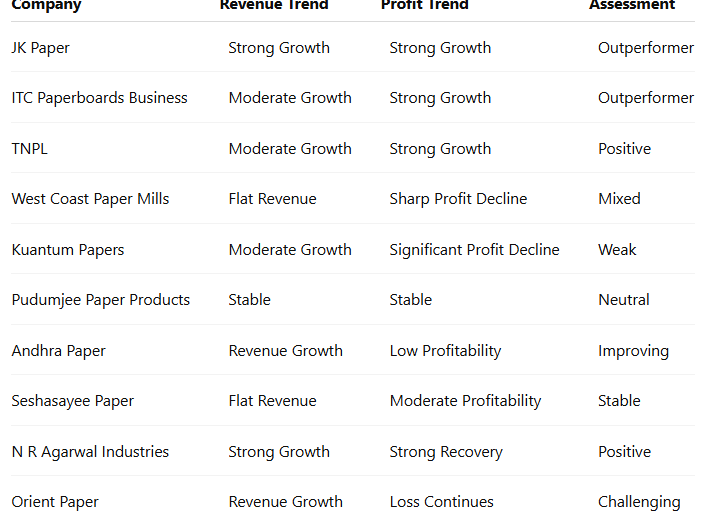
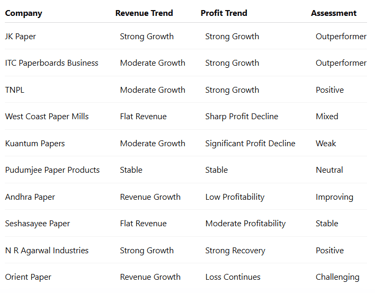
Sector Scorecard FY26
Industry-Wide Themes Emerging from FY26
1. Volume Growth Returned Across Most Segments
Paper consumption remained healthy across education, office stationery, packaging, FMCG, pharmaceuticals, e-commerce, and industrial applications.
Several companies reported improved sales volumes, while TNPL achieved the highest combined paper and paperboard sales volume in its history, highlighting continued demand resilience.
The strongest demand pockets were:
Packaging paper
Folding cartons
Specialty paper
Decor paper
Premium paperboard
Traditional writing and printing paper also remained stable, supported by educational demand.
2. Profitability Recovery Was Uneven
The biggest takeaway from FY26 is that revenue growth did not always translate into profit growth.
Winners
JK Paper delivered double-digit growth in revenue, EBITDA, and net profit.
ITC's Paperboards business reported over 20% growth in segment profits despite modest revenue growth.
TNPL generated stronger profits despite a difficult operating environment.
N R Agarwal achieved one of the strongest profit recoveries among listed paper manufacturers.
Laggards
Kuantum Papers experienced a sharp decline in earnings despite revenue growth.
West Coast Paper Mills reported a substantial reduction in annual profits.
Orient Paper remained loss-making, although losses narrowed.
The divergence suggests pricing remains under pressure in certain paper categories while cost advantages are benefiting integrated producers.
3. Wood Availability Improved
A major positive development for the industry during FY26 was improved wood availability.
Companies highlighted:
Better plantation yields
Expanded sourcing regions
Improved raw material procurement
Lower wood cost inflation
This particularly benefited integrated manufacturers with captive forestry programs.
Improved wood supply is likely to remain one of the strongest earnings drivers over the next 12–24 months.
4. Packaging Remains the Strongest Growth Engine
The packaging segment continues to outperform traditional paper categories.
Key trends include:
Growth in folding cartons
FMCG packaging demand
Food packaging applications
Pharmaceutical packaging
Premium consumer packaging
ITC specifically highlighted strong carton packaging growth while several companies continue expanding value-added paperboard capacities.
The long-term structural growth story remains centered on packaging rather than commodity writing paper.
5. Specialty Papers Becoming Increasingly Important
Specialty paper emerged as one of the fastest-growing categories during FY26.
Growth areas include:
Decor paper
Industrial paper
Food-grade paper
Sustainable packaging substrates
Premium paper applications
Companies with higher specialty paper exposure generally demonstrated better margin resilience than commodity-focused peers.
6. Import Competition Remains a Key Risk
Despite partial relief through Minimum Import Price measures, imported paper and paperboard continue to pressure domestic pricing.
Industry participants remain concerned about:
Low-priced imports
Excess global paper capacity
Chinese and Southeast Asian competition
Margin pressure from imported grades
The industry is likely to continue seeking protective measures from policymakers.
Company-by-Company Expert Commentary
JK Paper
JK Paper emerged as one of the strongest performers among major listed paper companies.
Revenue growth of over 16%, EBITDA growth of over 15%, and net profit growth exceeding 20% indicate healthy demand conditions and effective cost management.
The company's ability to expand earnings despite higher employee costs, depreciation, and interest expenses demonstrates strong operational execution.
Outlook: Positive.
ITC Paperboards, Paper & Packaging
ITC's paper business delivered one of the strongest margin recoveries in the sector.
Profit growth significantly outpaced revenue growth, indicating successful cost control and improved operating leverage.
Packaging and specialty papers continue to be major growth drivers.
Outlook: Strong Positive.
Tamil Nadu Newsprint and Papers (TNPL)
TNPL delivered a solid FY26 performance.
Record sales volumes combined with double-digit profit growth demonstrate operational strength despite market volatility.
The company's focus on value-added products appears to be yielding results.
Outlook: Positive.
West Coast Paper Mills
West Coast experienced a challenging year despite a stronger fourth quarter.
Annual profitability contracted sharply even though revenues remained relatively stable.
Improved operating cash flow provides some comfort, but earnings recovery remains a key focus area.
Outlook: Neutral.
Kuantum Papers
Kuantum reported one of the largest profit declines among peers.
Revenue growth was unable to offset margin compression and profitability challenges.
However, ongoing capital expenditure suggests management is positioning for future growth.
Outlook: Cautious.
Pudumjee Paper Products
Pudumjee delivered a stable performance.
Revenue, EBITDA, and profits remained largely unchanged, reflecting resilience in a difficult operating environment.
The company's hygiene products segment offers some diversification benefits.
Outlook: Stable.
Andhra Paper
Andhra Paper showed revenue growth but profitability remains subdued.
The Tissue Machine Project could become an important growth catalyst over the medium term.
Operational disruptions at the Kadiyam facility remain a near-term risk.
Outlook: Improving but watch operational risks.
Seshasayee Paper & Boards
The company maintained stable operations despite a softer revenue environment.
The Servalakshmi Paper asset acquisition could provide future growth opportunities if successfully revived.
Outlook: Stable with medium-term expansion potential.
N R Agarwal Industries
N R Agarwal was among the biggest turnaround stories of FY26.
Strong revenue growth combined with a substantial increase in net profit reflects improving operating conditions and successful execution.
Capacity expansion initiatives further strengthen long-term growth prospects.
Outlook: Positive.
Orient Paper & Industries
Orient Paper continues to face structural challenges.
Although losses narrowed compared to FY25, profitability remains elusive.
The paper business remains under pressure despite modest revenue growth.
Outlook: Challenging.
Sector Outlook FY27
The Indian paper industry enters FY27 with improving fundamentals.
Positive factors include:
Better wood availability
Growing packaging demand
Specialty paper expansion
Capacity additions
Improved domestic demand
Government support against unfair imports
Risks remain:
Import competition
Global paper oversupply
Energy cost volatility
Interest costs
Potential pricing pressure
Expert Verdict
FY26 marked a transition year for the Indian paper industry. While demand conditions improved meaningfully, earnings recovery was concentrated among companies with strong integration, specialty paper exposure, packaging capabilities, and disciplined cost structures.
JK Paper, ITC's Paperboards business, TNPL, and N R Agarwal emerged as the strongest performers. Companies dependent on commoditized paper grades continued to struggle with pricing pressures and margin compression.
The industry's long-term growth narrative remains intact, supported by rising packaging consumption, sustainability-driven paper substitution, specialty paper opportunities, and India's expanding manufacturing economy. The companies best positioned to benefit are those investing in value-added products, raw material security, and operational efficiency.