When the global pulp and paper industry moves, we report it first — trusted by 10000 subscribers across 85 countries

International Paper Announces Strategic Separation into Two Independent Public Companies
MARKET ANALYSIS
Jino John
1/31/20262 min read
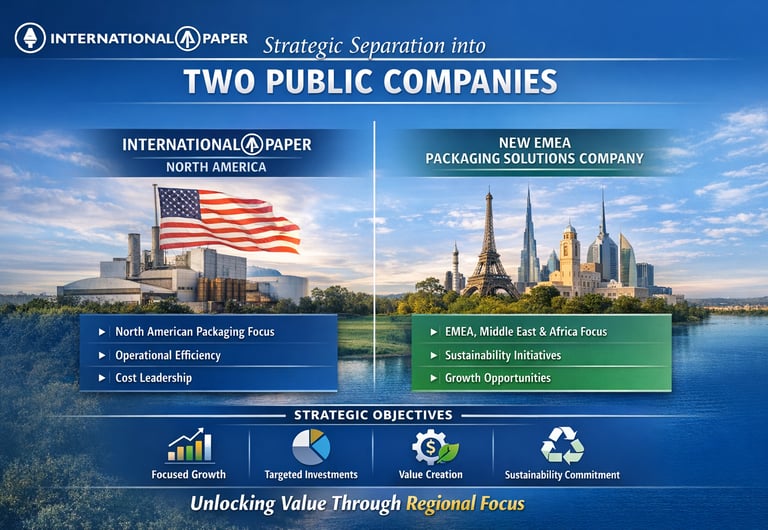
International Paper has announced a plan to separate into two independent, publicly traded companies, a move that signals more than a portfolio adjustment—it reflects a broader realignment underway across the global packaging and fiber-based materials industry.
Unveiled alongside full-year and Q4 2025 financial results, the proposed separation is designed to sharpen strategic focus, improve capital allocation discipline, and unlock long-term shareholder value by aligning businesses around distinct regional and operational realities.
📊 Context: Why Now?
The packaging sector is no longer a monolithic global market. Regional differences in:
demand growth,
regulatory pressure,
sustainability requirements,
cost structures, and
competitive dynamics
have become too pronounced to manage optimally under a single corporate structure.
International Paper’s footprint—spanning North America and Europe, the Middle East, and Africa (EMEA)—has increasingly required different investment horizons, operating models, and risk tolerances. The separation acknowledges this reality and positions each business to operate with greater strategic clarity and accountability.
🏗️ The Structure of the Separation
Under the plan:
1️⃣ International Paper (North America)
The remaining company will focus on the U.S. and Canadian packaging markets, where scale, mill integration, and logistics efficiency remain core competitive advantages. This business is expected to emphasize:
containerboard and box system optimization
cost leadership and operational reliability
disciplined capital investment amid a mature demand environment
2️⃣ EMEA Packaging Solutions Company
The newly formed EMEA-focused company will operate independently, allowing leadership to tailor strategy around:
structurally different demand patterns
higher regulatory and sustainability complexity
selective growth and margin optimization opportunities
Each company will have its own management team, balance sheet priorities, and strategic roadmap.
📈 Strategic Implications for Investors
From an investor perspective, this separation has several notable implications:
Improved Transparency: Distinct financial profiles will be easier to analyze and value independently.
Targeted Capital Allocation: Each company can pursue investments aligned with its market cycle rather than competing internally for capital.
Potential Multiple Expansion: Pure-play structures often receive higher valuation multiples when business models are clearer and risk profiles more focused.
Optionality: Independent companies may be better positioned for future M&A, partnerships, or regional consolidation.
In short, the move reduces complexity—and markets tend to reward clarity.
🌱 Sustainability and Operational Strategy
Importantly, the separation does not signal a retreat from sustainability commitments. Instead, it allows each company to pursue region-specific sustainability strategies, reflecting differences in regulation, customer expectations, and infrastructure.
This is especially relevant as fiber-based packaging increasingly sits at the intersection of:
circular economy policy
decarbonization targets
supply chain resilience
Localized decision-making may prove critical in navigating these pressures effectively.
🧠 Industry Signal: A Broader Trend
International Paper’s decision fits a broader pattern across heavy industry and materials sectors:
simplified portfolios
regionalized operating models
sharper management accountability
As global demand growth moderates and capital becomes more selective, focus is becoming a competitive advantage.
🔎 Bottom Line
This planned separation represents a strategic recalibration, not a retrenchment.
By creating two regionally focused public companies, International Paper is positioning itself to:
operate with greater agility,
align strategy more closely with market realities, and
compete more effectively in a rapidly evolving packaging landscape.
The success of the move will ultimately depend on execution—but strategically, the rationale is sound and timely.