When the global pulp and paper industry moves, we report it first — trusted by 10000 subscribers across 85 countries

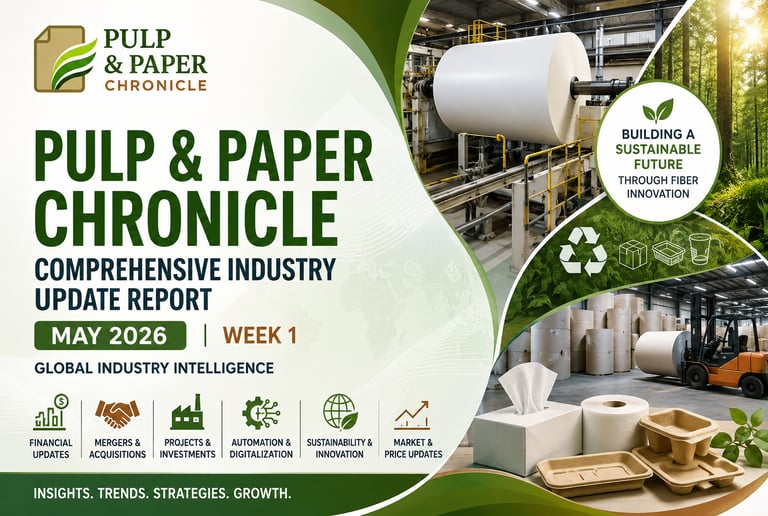
Pulp & Paper Chronicle Comprehensive Industry Update Report May 2026 | Week 1 Global Industry Intelligence
PAPER INDUSTRY NEWS
Jino John
5/12/20265 min read
Executive Overview
The global pulp, paper, tissue, packaging, and fibre-based materials industry entered May 2026 amid continued economic and operational pressure. Weak global demand, inflationary raw material costs, energy volatility, and oversupply in several pulp grades continued affecting profitability across producers. At the same time, the sector demonstrated accelerated transformation through:
Sustainability-driven packaging innovation
Strategic acquisitions and consolidation
AI and digital manufacturing investments
Tissue and specialty paper expansion
Circular economy material development
Operational restructuring and capacity optimization
Fibre-based plastic replacement technologies
Industry activity during Week 1 reflected a market simultaneously navigating short-term demand weakness while investing aggressively in long-term resilience, automation, and sustainable growth.
1. Global Industry Themes
1.1 Cost Pressure & Demand Weakness Continue
Several producers reported:
Lower EBITDA
Margin compression
Weak pulp pricing
Slower packaging demand
Higher operating costs
Affected companies included:
RYAM
Mercer International
MEPCO
Stora Enso
Irani
Sappi
Rottneros
At the same time, companies increasingly prioritized:
Free cash flow
Debt reduction
Operational optimization
Capacity discipline
Portfolio restructuring
1.2 Sustainability Becomes Core Competitive Strategy
The industry saw major acceleration in:
Fibre-based packaging
Circular materials
PFAS-free packaging
Recyclable barrier papers
Agricultural fibre utilization
Low-carbon manufacturing
Companies such as:
UPM
BASF
Duni Group
Mondi
Södra
WEPA
Honext
PulPac
led sustainability-focused innovation during the week.
1.3 AI, Automation & Digitalization Accelerate
Manufacturers increasingly adopted:
AI-based estimating
Smart logistics
Automated scheduling
Real-time manufacturing systems
Integrated packaging software
Digital supply-chain tools
Major developments came from:
Amtech Software
ePS
Tetra Pak
United Paper Mills (OBF)
1.4 Consolidation & Strategic Restructuring Intensify
The sector continued experiencing:
Mergers
Joint ventures
Strategic reviews
Asset acquisitions
Capacity rationalization
Geographic expansion
Notable developments included:
Suzano–Kimberly-Clark JV
Twin Rivers acquisition
CSI acquisition from Amcor
Marcal tissue acquisition
Essity strategic review
2. Financial Results & Earnings Review
2.1 Graphic Packaging Holding Company
Graphic Packaging reported softer packaging demand and continued market normalization in Q1 2026.
Strategic Priorities
Stronger free cash flow
Debt reduction
Operational efficiency
Sustainability investments
Renewable energy deployment
Management emphasized transition away from major capital expenditure cycles toward disciplined financial management and long-term resilience.
2.2 RYAM Reports Wider Q1 Loss
Rayonier Advanced Materials faced substantial earnings pressure.
Financial Performance
MetricQ1 2026Net Sales$319MNet Loss$81MAdjusted EBITDA$8M
Key Challenges
Weak cellulose specialties demand
Commodity pulp oversupply
China market weakness
Temiscaming idling charges
Despite losses:
Operating cash flow remained positive
Free cash flow improved
2.3 Kadant Reports Record Bookings
Kadant delivered one of the strongest quarterly performances in the sector.
Results
MetricPerformanceRevenue$281.5M (+18%)Bookings$320.8M (+25%)Adjusted EBITDA$56.8M
Growth Drivers
Industrial automation
Process equipment demand
Strategic acquisitions
Paper industry modernization projects
2.4 Amcor Delivers Strong Q3 FY2026
Amcor reported:
~$5.9B quarterly sales
Improved EBIT
Higher acquisition synergies
Raised earnings confidence
Berry Global Synergy Impact
Expected annual synergy savings increased to:
$270 million
Challenges
Inventory build-up
Geopolitical supply-chain disruptions
Free cash flow pressure
2.5 Klabin Reports Revenue Growth
Klabin demonstrated operational resilience despite difficult global conditions.
Highlights
Revenue growth
Stable operations
Export competitiveness
Packaging demand resilience
Focus remained on:
Integrated pulp and packaging strategy
Cost discipline
Operational continuity
2.6 Essity Launches Strategic Review
Essity initiated a strategic review of its Consumer Tissue business.
Possible Objectives
Portfolio optimization
Margin enhancement
Structural restructuring
Strategic repositioning
The review reflects broader consolidation trends in global tissue markets.
2.7 Irani Reports Lower Revenue
Irani experienced weaker quarterly performance due to:
Scheduled maintenance shutdowns
Reduced production
Lower sales volumes
The company expects operational normalization post-maintenance.
2.8 Lenzing Returns to Profitability
Lenzing reported:
Positive net results
Improved free cash flow
Better operational efficiency
Successful cost management
2.9 Rottneros Improves Cost Position
Rottneros continued navigating difficult pulp markets while improving:
Cost structures
Efficiency
Margin stabilization
2.10 Ahlstrom Delivers Record EBITDA Margin
Ahlstrom reported:
Strong specialty materials demand
Record Q1 EBITDA margin
Successful pricing discipline
2.11 Sappi Reports Challenging Conditions
Sappi highlighted:
Weak demand
Pricing pressure
Strategic innovation investments
Packaging diversification efforts
2.12 Mercer International Reports Lower EBITDA
Mercer faced:
Weak pulp pricing
Margin compression
Lower EBITDA
Soft market demand
2.13 Karat Packaging Reports Revenue Growth
Karat Packaging achieved:
Higher sales volume
Revenue expansion
Foodservice packaging growth
2.14 MEPCO Reports Net Loss
MEPCO recorded:
Lower selling prices
Earnings pressure
Margin weakness
2.15 Stora Enso Reports Weak Q1 Earnings
Stora Enso faced:
Weak demand
Oulu ramp-up costs
Lower profitability
The company also introduced:
“Bergslagets Skogar” as the new identity for its Swedish forest asset platform.
3. Mergers, Acquisitions & Strategic Partnerships
3.1 Suzano–Kimberly-Clark Tissue JV ($3.4B)
The industry’s largest transaction this week involved Suzano’s proposed acquisition of:
51% stake in Kimberly-Clark international tissue operations
Geographic Scope
22 manufacturing sites
Europe
Asia
Middle East
South America
Africa
Oceania
EU approval is expected without conditions.
3.2 Closure Systems International Acquires Amcor Facilities
CSI acquired:
Erie, Pennsylvania facility
Hattiesburg, Mississippi facility
Strategic Benefits
Beverage closure expansion
Increased North American footprint
Capacity growth
3.3 Twin Rivers Acquires Potsdam Specialty Paper
Twin Rivers strengthened:
Specialty saturated papers
Latex and acrylic base papers
Technical fibre capabilities
3.4 Marcal Acquires St. Catharines Tissue Mill
Marcal expanded tissue operations through acquisition of:
St. Catharines tissue facility
Additional converting capacity
3.5 Star Paper Mill Expands International Partnerships
Partnerships signed with:
Heinzel Sales
Ekman & Co. AB
Objectives:
68,000 MT exports
UAE manufacturing expansion
Circular economy development
4. Investments, Capacity Expansion & New Projects
4.1 TNPL Enters Tissue Segment
TNPL produced its first jumbo reel at Unit 2 and launched:
“LUMEA” tissue brand
Technology partner:
ANDRITZ
4.2 Cullen Sustainable Packaging Invests £5M
Investment targets:
Production expansion
Workforce growth
Moulded fibre systems
Key project:
Machine 8000
4.3 Suparma Group Tissue Expansion
ANDRITZ secured:
PrimeLine tissue machine order
Automation systems
Digital manufacturing technology
Strategic focus:
Indian tissue growth
4.4 Boxon Launches Morocco Operations
Boxon established:
Local manufacturing
Warehousing
Regional logistics operations
4.5 WEPA–Honext Circular Fibreboard Project
Supported by:
European Investment Bank
Focus:
Recycled-content fibreboards
Sustainable construction materials
5. Sustainability & Packaging Innovation
5.1 UPM + BASF Recyclable Packaging Partnership
The partnership combines:
Fibre barrier papers
Recyclable coatings
High-performance packaging systems
Strategic driver:
EU recyclability regulations
5.2 UPM, Michelman & BOBST Bio-Based Packaging
Companies introduced:
Bio-based flexible packaging concepts
Fibre alternatives to plastics
Sustainable barrier technologies
5.3 Duni Launches Black Fibre Packaging
Products:
Tray Contrast
Ronda Contrast
Features:
PFAS-free
FSC-certified
Recyclable
5.4 PulPac Dry Molded Fibre Meat Trays
Zipform licensed PulPac technology for:
Fibre meat trays
Plastic replacement packaging
Benefits:
Lower water use
Lower energy use
High-speed manufacturing
5.5 Mondi Develops Digital Kraftliner Packaging
Mondi introduced:
White digital printing on kraftliner
QR-enabled traceability
Premium recyclable packaging
5.6 Södra Develops Oat Hull Hybrid Pulp
Innovation combines:
Forest fibre
Agricultural waste streams
Represents:
Raw-material diversification
Circular economy advancement
5.7 UPM Introduces QSR Receipt Materials
UPM launched:
Specialized receipt papers
Improved restaurant order accuracy solutions
6. AI, Automation & Digitalization
6.1 Amtech Intelligence Platform
Amtech launched AI-enabled systems featuring:
Automated quoting
ERP integration
Packaging workflow optimization
Acquisition:
Clarico Systems
6.2 ePS Launches CommandCore
Capabilities:
Centralized packaging control
Real-time analytics
Downtime reduction
6.3 United Paper Mills Digitizes Logistics
Implemented:
Electronic scheduling
Vehicle tracking
Automated logistics coordination
Result:
33% turnaround reduction
6.4 Tetra Pak Advanced Agreements Gain Recognition
Recognized for:
Digitally enabled manufacturing optimization
Guaranteed OEE improvements
Long-term operational partnerships
7. Restart, Shutdowns & Operational Events
7.1 SNCPA Five-Year Restructuring Plan
Tunisia’s SNCPA plans:
Production restoration
Alfa pulp restart
Chemical plant rehabilitation
7.2 Voith Paper Machine Rebuild
Voith secured:
Comprehensive rebuild contract
Stock preparation modernization
Objectives:
Higher efficiency
Improved reliability
Automation enhancement
7.3 Daio Paper Mishima Shutdown
Wastewater piping failure caused:
Partial shutdown
Repair operations
Safety reviews
7.4 Smurfit Westrock Railcar Fire
Major fire incident required:
Four-hour emergency response
Heavy equipment support
7.5 Domtar Crofton Site Draws Buyers
Potential future uses:
Manufacturing
Energy development
Industrial infrastructure
8. Product Launches & Consumer Innovation
8.1 Clean Nara Revamps Bosomi Wipes
Enhancements:
Hypoallergenic safety
Product segmentation
Chemical-free positioning
8.2 Northwood Relaunches Leonardo Brand
New features:
Recycled tissue systems
Transparent dispensers
Hygiene optimization
9. Price Updates
9.1 Arctic Paper Announces Price Increase
Price increases:
4–8%
Coated and uncoated fine papers
Effective June 2026
Drivers:
Energy inflation
Logistics costs
Raw material pressure
10. Strategic Outlook
Key Industry Conclusions
1. Fibre-Based Packaging Is Becoming Mainstream
The industry is rapidly transitioning away from plastic packaging toward recyclable fibre systems.
2. AI & Automation Are Becoming Essential
Operational digitization is moving from optional to mandatory across manufacturing and logistics.
3. Financial Discipline Is Dominating Strategy
Companies increasingly prioritize:
Cash generation
Margin protection
Cost optimization
4. Consolidation Will Continue
Large-scale acquisitions and strategic reviews indicate further sector consolidation ahead.
5. Sustainability Is the Primary Long-Term Investment Theme
The strongest investments continue targeting:
Circular materials
Recyclable packaging
Renewable fibres
Low-carbon manufacturing
Final Industry Assessment
May 2026 Week 1 revealed a pulp and paper industry undergoing accelerated transformation. While weak demand and pricing pressure continue impacting profitability, the sector is aggressively repositioning itself around:
Sustainable packaging
AI-enabled manufacturing
Fibre innovation
Circular economy systems
Geographic expansion
Strategic restructuring
Operational resilience
The companies investing most heavily in sustainability, automation, and specialty materials continue emerging as the long-term strategic leaders of the global pulp, paper, and packaging industry.