When the global pulp and paper industry moves, we report it first — trusted by 10000 subscribers across 85 countries

Pulp & Paper Chronicle’s Industry Update – April 2026
MARKET ANALYSIS
Jino John
5/7/20266 min read
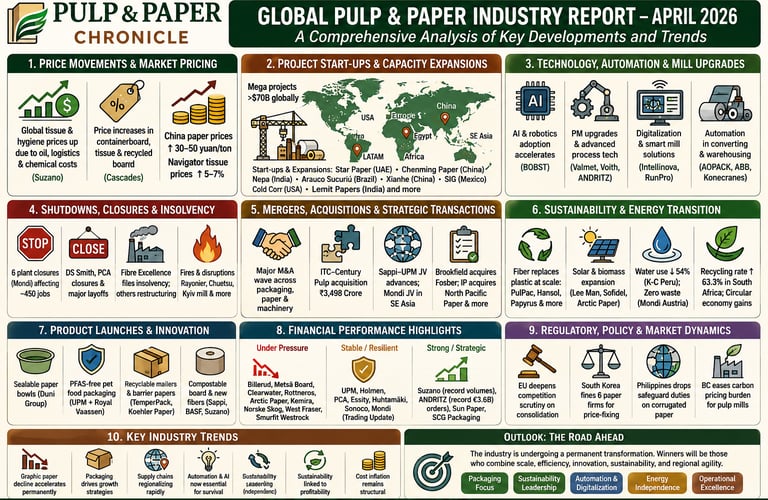
Exclusive Monthly Industry Intelligence Report
April 2026 marked one of the most transformational periods for the global pulp, paper, packaging, tissue, and converting industries in recent years. Across every region, the industry faced simultaneous structural pressure and strategic opportunity. The month was defined by aggressive consolidation, major capital investments, rising operational risk, accelerating sustainability mandates, and the rapid evolution of fiber-based packaging as a replacement for plastics.
🌍 MEGA THEMES DEFINING APRIL 2026
Structural decline in graphic paper accelerating
Traditional printing and writing paper segments continued contracting globally, forcing producers to restructure operations, reduce capacity, and redirect investments toward packaging and specialty grades.
Packaging dominates industry growth strategies
Corrugated packaging, recycled containerboard, paper bags, molded fiber, and food-service packaging remained the industry’s strongest growth engines.
Sustainability becomes a profitability driver
Sustainability is no longer treated as a compliance initiative. Companies are directly linking ESG execution with operational efficiency, cost savings, investor attractiveness, and long-term competitiveness.
Digitalization and AI reshape mill operations
AI-driven quality control, smart manufacturing, predictive maintenance, automation systems, digital printing, and integrated mill intelligence accelerated rapidly across the sector.
Cost inflation remains structural
Energy, logistics, chemicals, recovered paper, pulpwood, and labor inflation continued to pressure margins despite gradual volume recovery in several markets.
Consolidation wave intensifies
Acquisitions, joint ventures, recapitalizations, and strategic reviews accelerated globally as companies pursued scale, specialization, and geographic expansion.
🔴 1. GLOBAL FINANCIAL PERFORMANCE & EARNINGS SNAPSHOT
Margin pressure remained the central global story
Across the industry, volume recovery failed to fully offset escalating production costs and pricing volatility.
Companies facing profitability pressure
Billerud reported improved volumes but EBITDA margins collapsed to nearly 5%.
Metsä Board experienced a sharp decline in profitability amid weak European demand.
Clearwater Paper reported severe EBITDA deterioration.
Rottneros AB posted negative EBITDA and initiated a SEK 300 million rights issue for liquidity support.
Arctic Paper faced margin compression and falling sales.
Kemira, Norske Skog, and Segezha Group all reported weak quarterly results due to pricing pressure and market softness.
West Fraser recorded losses linked to duties and weak wood-product markets.
Companies maintaining resilience
UPM-Kymmene Corporation maintained relatively stable margins while energy operations supported profitability.
Holmen benefited from strong renewable energy contributions.
Packaging Corporation of America delivered relatively stable packaging-driven performance.
Essity maintained margins through pricing discipline and cost management.
Huhtamäki sustained operational stability despite inflationary conditions.
Sonoco improved profitability through pricing and cost optimization despite lower sales volumes.
Strong strategic performers
Suzano delivered record shipment volumes despite foreign exchange pressure.
ANDRITZ announced a record €3.6 billion order intake, highlighting sustained global capital investment momentum.
SCG Packaging posted profit growth supported by Indonesian market recovery.
Sun Paper achieved revenue and profit growth driven by capacity expansion and operational upgrades.
Key industry takeaway
The industry is transitioning into a structurally lower-margin environment where efficiency, scale, automation, and energy integration increasingly determine competitiveness.
🟠 2. MERGERS, ACQUISITIONS & STRATEGIC CONSOLIDATION
April saw one of the strongest consolidation waves in recent industry history.
Major acquisitions and strategic deals
Kadant acquired voestalpine BÖHLER Profil.
CCL Industries acquired ALT Technologies.
ITC announced acquisition of Century Pulp in a ₹3,498 crore consolidation deal.
Brookfield acquired Fosber Group, strengthening packaging machinery capabilities.
International Paper acquired North Pacific Paper Company.
Imperial Dade Canada acquired Enterprise Paper.
Dunapack Packaging acquired Stora Enso’s German corrugated operations.
Nefab Group acquired Vallos Packaging Solutions.
Cartonpack Group acquired Agrypack’s business unit in Italy.
The Royal Group acquired Chillicothe Packaging and Churmac Industries.
Joint ventures and strategic alliances
Sappi–UPM JV advanced European graphic paper consolidation plans pending regulatory approval.
Mondi formed a Southeast Asia paper bag expansion JV.
UPM + Felix Schoeller expanded fiber-based barrier packaging collaboration.
Amcor accelerated fiber-packaging partnerships.
Aristo + Stora Enso collaborated on dispersion barrier board technology.
Regulatory scrutiny intensifies
The European Commission initiated deeper competition investigations into major industry consolidation efforts.
South Korea launched lawsuits and price-fixing investigations involving packaging producers.
Industry implication
The industry is rapidly consolidating around integrated packaging ecosystems, technology specialization, and regional supply chain dominance.
🔴 3. CLOSURES, LAYOFFS & RESTRUCTURING WAVE
Structural downsizing accelerates
The decline of traditional paper segments triggered widespread restructuring activity.
Major closures and workforce reductions
Mondi announced six plant closures impacting approximately 450 jobs.
DS Smith closed the Launceston facility affecting 167 workers.
Manroland Sheetfed shutdown affected more than 660 employees.
Papresa entered liquidation proceedings.
Packaging Corporation of America closed its Richmond facility affecting 110 workers.
Valmet announced temporary layoffs impacting 2,400 employees.
Andhra Paper Limited faced strike-related disruptions.
Fibre Excellence filed for insolvency amid soaring wood and energy costs.
Operational disruptions
Kyiv Cardboard & Paper Mill halted operations after a drone attack.
Rayonier experienced a major fire at its Jesup mill.
Chuetsu Pulp & Paper restarted operations after fire-related disruption.
Georgia-Pacific and Suzano initiated major maintenance shutdowns.
Key takeaway
Capacity rationalization is becoming structural rather than cyclical, especially in graphic paper markets.
🟢 4. EXPANSION, CAPEX & MEGA PROJECTS
Despite profitability pressure, global investment activity remained exceptionally strong.
Mega industrial investments
Sinar Mas Jinguang Project in China advanced with a staggering $77.6 billion investment.
Arauco Sucuriú Project ($4.6 billion) moved ahead of schedule.
Xianhe Co. launched a 1.3 million tpa project.
Bohui Paper initiated five upgrade projects adding 1.15 million tonnes of capacity.
General Emballage partnered with ANDRITZ for Africa’s largest paper machine.
Regional expansion & logistics
Suzano expanded North American logistics and terminal infrastructure.
Arauco Brasil invested $400 million into Santos port logistics.
Grupo Corporativo Papelera expanded U.S. operations.
SIG doubled Mexico capacity.
Jieya invested $68 million into Egyptian operations.
Packaging & recycled fiber expansion
Star Paper Mill (UAE) launched recycled containerboard operations.
Lemit Papers expanded recycled fiber capacity with a 150 TPD deinking line.
Cold Corr launched the first U.S. cold corrugation facility.
Chenming Paper restarted full production with 5.8 million tons capacity.
Strategic trend
Investment is overwhelmingly concentrated in:
Packaging
Recycled fiber
Export logistics
Energy integration
Emerging markets
🟡 5. TECHNOLOGY, AUTOMATION & INDUSTRY 4.0
Technology investments accelerated globally as companies sought operational efficiency and lower costs.
Major automation and process upgrades
BOBST advanced AI-driven robotics systems.
AOPACK introduced integrated digital box-making systems enabling ultra-short-run corrugated production.
Flex Asepto Egypt deployed ABB automation technologies.
Konecranes modernized warehouse automation systems.
Runtech Systems improved dryer section efficiency.
Valmet continued extensive modernization partnerships globally.
Advanced paper machine developments
Zhejiang Forest United Paper launched the world’s first OptiDry Coat double-pass air drying system.
Voith successfully started up the first DuoCentri NipcoFlex press with center belt technology.
JK Paper commissioned a 400 ADMT/day BCTMP facility with Valmet technology.
Kuantum Papers upgraded PM2 systems including QCS and DCS automation.
Industry implication
Automation is no longer optional — it has become central to survival, quality optimization, labor reduction, and energy efficiency.
♻️ 6. SUSTAINABILITY, ENERGY & CIRCULAR ECONOMY
April confirmed sustainability as the defining long-term industry investment theme.
Fiber replacing plastic at scale
Hansol Paper launched Protego HS paper-based packaging.
PulPac accelerated dry molded fiber commercialization.
Papyrus Australia advanced banana-fiber packaging commercialization.
Indonesia accelerated shifts from plastic toward paper and glass packaging.
Tetra Pak and Sterilgarda introduced paper-based aseptic barriers.
ESG execution and renewable energy
Kimberly-Clark Peru reduced water use by 54%.
Lee Man Paper launched solar power projects.
Arctic Paper invested SEK 285 million into pellet production.
Sofidel expanded photovoltaic energy systems.
Burgo Group advanced renewable energy transition programs.
Domtar intensified emissions and water-risk mapping initiatives.
Recycling & circular economy
South Africa’s paper recycling rate rose to 63.3%.
Mondi Austria achieved one year of zero waste to landfill.
RDM Group accelerated recycled cartonboard adoption initiatives.
Industry takeaway
Sustainability investments are increasingly tied directly to:
Margin improvement
Regulatory compliance
Energy independence
Investor attractiveness
Customer retention
📦 7. PRODUCT LAUNCHES & MATERIAL INNOVATION
Sustainable packaging breakthroughs
Duni Group introduced sealable paper bowls using MAP technology.
BASF expanded ecovio® compostable materials.
Nippon Paper launched SHIELDPLUS® solutions.
Koehler Paper introduced recyclable barrier paper.
UPM + Royal Vaassen developed PFAS-free pet food packaging.
TemperPack launched recyclable mailers replacing corrugated boxes.
Specialty and high-performance paper innovations
Stora Enso introduced Trayforma Brown.
MM Board & Paper launched ALASKA® BRIGHT NEW.
Troitskaya Paper developed antibacterial parchment paper using silver-ion technology.
Lecta expanded thermal and metallized paper offerings.
Strategic implication
Innovation priorities are converging around:
Recyclability
Lightweighting
Barrier performance
Food-contact compliance
Cost reduction
🔵 8. PRICING, COST INFLATION & MARKET VOLATILITY
Global pricing pressure intensifies
Suzano announced $50/ton pulp price increases.
Navigator increased tissue prices by 5–7%.
Cascades implemented broad packaging price hikes.
China paper markets recorded coordinated price increases.
Corrugated producers globally passed through higher kraft paper and energy costs.
Regulatory interventions
South Korea’s FTC fined six paper companies for price-fixing and ordered rollbacks.
The Philippines removed safeguard duties on imported corrugated paper.
Industry takeaway
Pricing volatility remains one of the industry’s greatest risks, with costs increasingly becoming structurally embedded rather than temporary.
⚫ 9. INDUSTRY STRUCTURAL SHIFTS
Major long-term shifts accelerating globally
Graphic paper demand continues structural decline.
Packaging remains the industry’s dominant growth platform.
AI and digital printing are transforming publishing and converting.
Private-label tissue demand continues rising.
Supply chains are regionalizing rapidly due to geopolitical instability.
Biomass, pellets, and renewable energy are becoming integrated profit centers.
🔮 FINAL STRATEGIC OUTLOOK
April 2026 confirmed that the global pulp and paper industry has entered a permanent transformation era.
The industry is no longer operating within traditional cyclical dynamics. Instead, companies are navigating:
Structural cost resets
Accelerated sustainability mandates
Packaging-led growth
Automation-driven competitiveness
Consolidation-led market reshaping
Energy integration and resilience strategies
The winners of the next decade will likely be companies capable of combining:
Scale
Digital manufacturing
Circular economy integration
Renewable energy systems
High-performance fiber innovation
Regional supply chain agility
The industry’s future is increasingly clear:
Packaging, sustainability, automation, and energy integration are becoming the four pillars of long-term competitiveness.