When the global pulp and paper industry moves, we report it first — trusted by 10000 subscribers across 85 countries

Report on European Chemical Market Pulp
MARKET ANALYSIS
Jino John
3/16/20262 min read
1. Introduction
The European chemical market pulp statistics for January 2026 were published by the UTIPULP Secretariat in Paris. The report analyzes pulp consumption and inventory levels across UTIPULP member countries, which include Austria, Belgium, France, Germany, Italy, the Netherlands, Poland, Portugal, Spain, and the United Kingdom.
The data focuses on chemical market pulp consumption and inventories, divided into categories such as unbleached pulp and bleached/semi-bleached pulp, as well as hardwood and softwood pulp types. The statistics provide insight into market demand, stock levels, and year-over-year changes.
2. Pulp Consumption Analysis
2.1 Consumption in January 2026
The total consumption of chemical market pulp in UTIPULP countries during January 2026 shows varying trends across pulp categories.
Unbleached Pulp
Hardwood: 7,489 tons (+0.6% compared to the previous year)
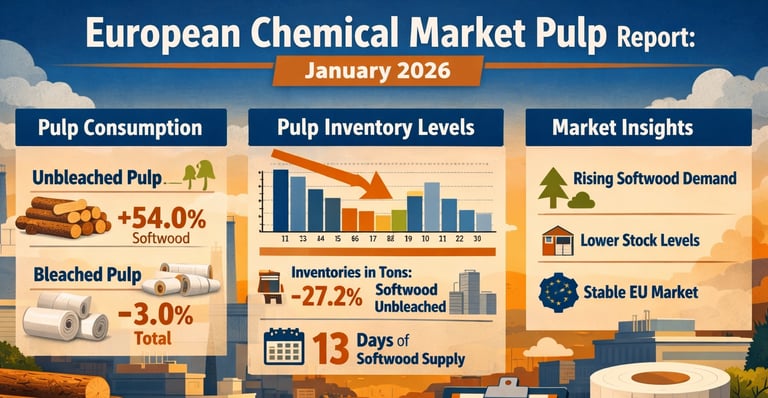
Softwood: 18,669 tons (+54.0% year-over-year increase)
Total: 31,443 tons (+9.3% increase)
Bleached or Semi-Bleached Pulp
Hardwood: 526,510 tons (−1.6%)
Softwood: 218,312 tons (−10.3%)
Total: 802,423 tons (−3.0%)
Key Observations
Softwood unbleached pulp consumption increased sharply (+54%), indicating rising demand for this pulp type.
Bleached or semi-bleached pulp consumption decreased overall by 3%, suggesting reduced demand in certain industrial segments.
Hardwood pulp consumption remained relatively stable.
3. Inventory Levels
3.1 Inventories in Tons (January 2026)
Unbleached Pulp
Hardwood: 8,113 tons (−9.9%)
Softwood: 6,010 tons (−27.2%)
Total: 28,731 tons (+8.9%)
Bleached or Semi-Bleached Pulp
Hardwood: 433,765 tons (−4.4%)
Softwood: 204,883 tons (−8.6%)
Total: 681,502 tons (−5.5%)
Key Observations
Inventory levels declined across most categories.
The largest decrease occurred in softwood unbleached pulp inventories (−27.2%).
Lower inventories could indicate improving market demand or tighter supply conditions.
3.2 Inventories in Days (January 2026)
Inventory duration represents the number of days current stock can support production.
Unbleached Pulp
Hardwood: 34 days (+5.6%)
Softwood: 13 days (−49.7%)
Total: 28 days (+2.1%)
Bleached or Semi-Bleached Pulp
Hardwood: 25 days (−3.5%)
Softwood: 27 days (+1.5%)
Total: 26 days (−2.7%)
Key Observations
Softwood unbleached pulp inventories dropped significantly in terms of days of supply, suggesting faster usage or reduced stock levels.
Bleached pulp inventories remained relatively stable with minor fluctuations.
4. Market Trends and Implications
1. Demand Shifts
The substantial increase in softwood unbleached pulp consumption indicates a possible shift in industrial demand or production patterns.
2. Inventory Reduction
Lower inventory levels across several pulp types suggest:
Stronger market demand
Improved supply chain efficiency
Strategic inventory management by manufacturers
3. Market Stability
Despite fluctuations in specific pulp categories, overall pulp consumption remains relatively stable in the European market.
Conclusion
The January 2026 UTIPULP report highlights moderate shifts in the European chemical pulp market. While overall consumption of bleached pulp slightly declined, demand for unbleached softwood pulp increased significantly. At the same time, inventory levels generally decreased, suggesting improved demand conditions and tighter stock management across UTIPULP countries.
These trends indicate that the European pulp market remains stable but is experiencing changing demand patterns between pulp types, which could influence production strategies and supply chain planning in the coming months.