When the global pulp and paper industry moves, we report it first — trusted by 10000 subscribers across 85 countries

Spain’s Paper and Pulp Industry in 2024- A Data-Driven Sustainability Performance Review
PAPER INDUSTRY NEWS
Jino John
2/25/20263 min read
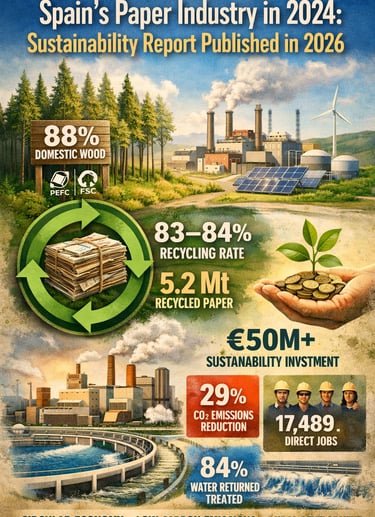
The 2024 Sustainability Report published by ASPAPEL provides a comprehensive, data-backed overview of the environmental, economic, and social performance of Spain’s pulp and paper industry. The report positions the sector as a key contributor to circular economy objectives, climate mitigation, and rural development, supported by measurable progress across resource efficiency, emissions reduction, recycling performance, and responsible sourcing.
This article consolidates the full set of disclosed performance indicators into a structured, data-driven analysis.
1. Responsible Sourcing and Forest Management
Sustainable Raw Material Base
88% of the wood used in Spanish pulp production originates from domestic plantations.
These plantations are managed under sustainable forestry standards and function as active carbon sinks, contributing to climate mitigation.
Certified chain-of-custody systems (PEFC and FSC) ensure traceability and responsible forest management throughout the supply chain.
Climate Function of Plantations
Sustainably managed plantations serve a dual environmental purpose:
Continuous renewable raw material supply.
Carbon sequestration during tree growth cycles.
This model supports bio-based industrial production while aligning with EU forestry and biodiversity frameworks.
2. Circular Economy Leadership
Recycling Performance
Spain remains one of Europe’s leaders in paper recycling, with:
5.2 million tonnes of paper and cardboard recycled in 2024
Recycling rate: 83–84%
Paper is inherently circular: fibers can be reused multiple times before final valorization. The Spanish industry operates within a closed-loop material system, reducing landfill dependency and decreasing reliance on virgin raw materials.
Waste Valorization
78% of production waste is valorized
Includes energy recovery, material reuse, and industrial symbiosis applications.
This reflects a high level of circular integration at the manufacturing stage.
3. Climate and Energy Performance
Emissions Reduction
29% reduction in CO₂ emissions since 2020
Achieved despite a moderate increase in production output.
This indicates structural decarbonization rather than cyclical reduction.
Energy Profile
82% of electricity consumed is self-generated
Increasing use of biomass and biogas as renewable energy sources.
Strong reliance on cogeneration and on-site energy systems.
The sector’s high rate of internal energy generation improves efficiency and reduces grid dependency, supporting both resilience and emissions reduction.
4. Water Stewardship
Water management remains central to pulp and paper manufacturing.
84% of water used in production is treated and returned to the environment
Continuous improvements in water recirculation and efficiency.
The industry applies closed-loop water systems and advanced treatment processes, reducing net freshwater withdrawal impact.
5. Economic and Social Impact
Employment
17,489 direct jobs in 2024.
Tens of thousands of indirect jobs across forestry, logistics, and supply chains.
High proportion of permanent employment contracts.
Regional Development
Facilities are predominantly located in:
Rural
Semi-urban
Industrial transition regions
This geographic footprint contributes to:
Rural economic stabilization
Local industrial diversification
Long-term territorial cohesion
6. Investment in Sustainability
More than €50 million invested in sustainability initiatives in 2024
Investments target:
Emissions reduction technologies
Energy efficiency upgrades
Waste valorization systems
Water treatment improvements
Process modernization
Capital allocation reflects strategic alignment with long-term decarbonization and EU Green Deal objectives.
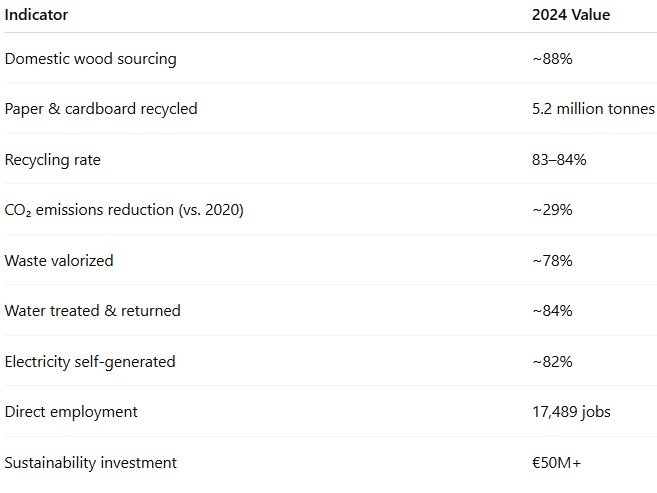
7. Key Performance Indicators (2024)
8. Structural Sustainability Model
The Spanish pulp and paper industry operates under an integrated sustainability model built on:
Renewable raw materials
High recycling efficiency
Industrial decarbonization
Energy self-sufficiency
Water stewardship
Rural economic support
The data suggests that sustainability is embedded structurally rather than implemented as a compliance exercise. The sector demonstrates measurable progress across environmental metrics while maintaining economic output and employment.
Conclusion
The 2024 sustainability data shows a mature, metrics-driven industry transitioning toward deeper decarbonization while maintaining high circularity and strong regional socio-economic impact.
Key achievements include:
Near-85% recycling rate
Almost one-third reduction in CO₂ emissions since 2020
Majority domestic sustainable wood sourcing
High waste valorization
Strong renewable energy integration
Significant sustainability investment
Spain’s paper and pulp industry presents a consolidated example of industrial circular economy implementation at national scale—backed by measurable indicators and multi-year performance improvement.