When the global pulp and paper industry moves, we report it first — trusted by 10000 subscribers across 85 countries

Tariff Revolution: U.S. Reduces Duties on Indian Goods — Direct Impact on the Paper Industry
MARKET ANALYSIS
Jino John
2/3/20262 min read
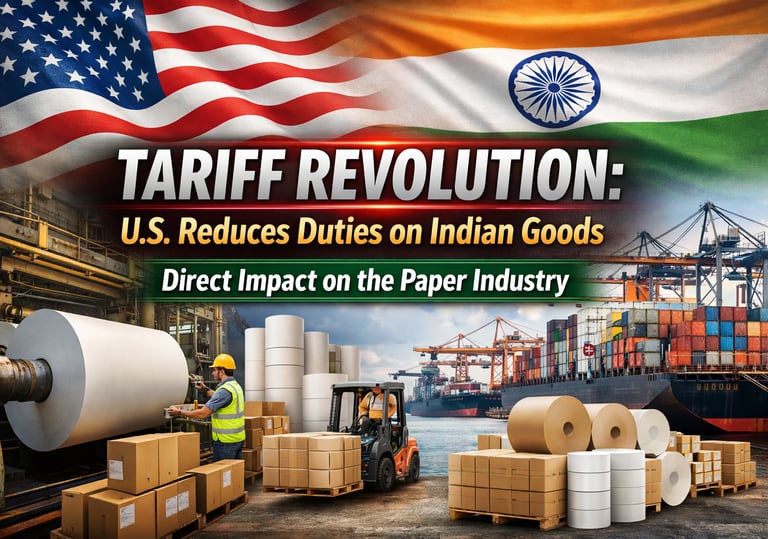
The recent decision by the United States to reduce tariff barriers on Indian goods marks a major shift in bilateral trade policy with India. While the announcement spans several industries, its consequences for the paper and pulp sector are both immediate and structural.
For Indian paper manufacturers, this is not merely a trade headline—it alters cost equations, export feasibility, and long-term market positioning in one of the world’s largest paper-consuming economies.
Trade Policy Shift and Market Access
Lower U.S. import duties improve the landed cost of Indian goods, making them more competitive against suppliers from Europe and East Asia. For paper products—where margins are sensitive to freight and duty structures—this change directly affects price viability.
Reduced tariffs create:
Better entry conditions for Indian paper exports
Greater acceptance of Indian-origin products by U.S. buyers
Scope for long-term supply contracts rather than spot shipments
Key Effects on the Paper Industry
1. Export Competitiveness Improves
Indian producers of:
Writing & printing paper
Kraft and sack paper
Duplex and packaging board
Specialty and coated grades
can now approach U.S. buyers with improved price positioning. Even small tariff reductions translate into meaningful cost advantages in bulk paper trade.
2. Stronger Demand for Packaging Grades
The U.S. market continues to expand in:
E-commerce packaging
Food and beverage cartons
Pharmaceutical and FMCG packaging
Lower tariffs strengthen the business case for sourcing kraft paper and paperboard from India, especially for converters seeking alternatives to traditional suppliers.
3. Shift in Global Supply Chains
Buyers are increasingly diversifying supply away from politically sensitive or tariff-heavy regions. India’s improved tariff status places it as:
A strategic supplier to U.S. importers
A potential replacement for higher-cost origins
A stable sourcing option for sustainable packaging
This encourages structural realignment rather than temporary trade flows.
4. Pressure on Domestic Market
If reciprocal tariff reductions apply to U.S. paper or pulp imports into India:
Imported pulp could become cheaper
Specialty paper imports may increase
Domestic pricing could face pressure
Indian mills will need to balance export growth with rising import competition.
Quality, Compliance and Certification
U.S. buyers demand:
Consistent grammage and strength properties
Food-contact and safety compliance
Environmental and chain-of-custody certification
This trade shift will likely push Indian mills toward:
Higher quality benchmarks
Improved process control
Greater focus on value-added grades
The policy change therefore acts as a catalyst for modernization.
Sustainability as a Competitive Tool
With increasing U.S. preference for paper over plastic, Indian producers using:
Agro-based fiber
Recycled raw materials
Low-emission processes
can position themselves as sustainable suppliers rather than just low-cost exporters.
Industry Outlook
The tariff adjustment changes trade economics in favor of Indian exporters. For the paper industry, this means:
✔ Greater incentive to target the U.S. market
✔ Improved export margins
✔ Increased investment focus on packaging and specialty grades
✔ Heightened competition both abroad and at home
This is not a short-term opportunity but a structural change in trade access.
Conclusion
The reduction of U.S. tariffs on Indian goods represents a turning point for India’s paper sector. It reshapes export feasibility, influences capacity planning, and forces a strategic rethink of market priorities.
For Indian paper manufacturers, the message is clear:
The U.S. market is now more accessible—but only for mills that can meet price, quality, and sustainability expectations.