When the global pulp and paper industry moves, we report it first — trusted by 10000 subscribers across 85 countries

The European Pulp and Paper Industry in 2025: A Sector in Transition
MARKET ANALYSIS
Jino John
7/6/20265 min read
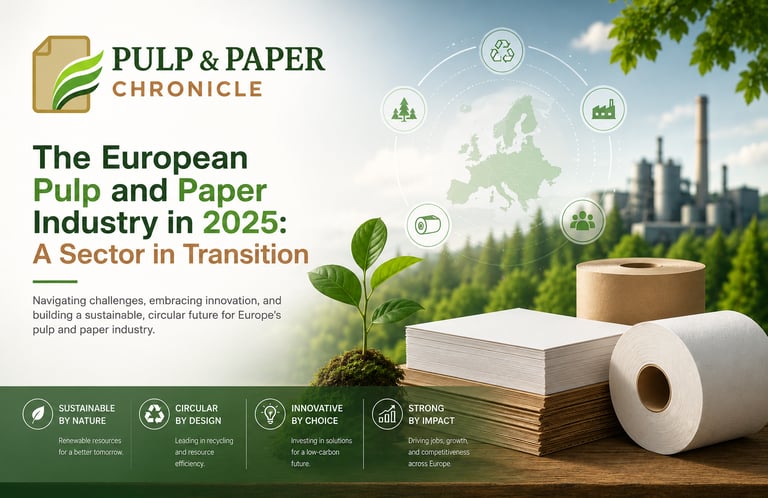
The European pulp and paper industry entered 2025 navigating a complex economic landscape marked by slower industrial demand, geopolitical uncertainty, persistent cost pressures, and evolving sustainability regulations. Despite these challenges, the sector continues to demonstrate remarkable resilience, maintaining its position as one of Europe's most circular, export-oriented, and environmentally progressive manufacturing industries.
According to the latest Cepi Key Statistics 2025, the European pulp and paper sector remains a cornerstone of the continent's industrial economy. Representing approximately 90% of European pulp and paper production, the industry directly employs 176,387 people, generates an annual turnover of €95 billion, contributes approximately €18 billion to European GDP, and encompasses around 620 companies operating 740 mills across 19 European countries.
Although production volumes declined slightly during 2025, the industry's long-term transformation toward higher-value products, increased recycling, renewable energy, and resource efficiency continued to accelerate, reinforcing Europe's leadership in sustainable paper manufacturing.
A Strategic Industry Undergoing Structural Transformation
The European pulp and paper industry has undergone significant structural evolution over the past three decades. Since 1991, consolidation, technological modernization, and increased production efficiency have dramatically reshaped the sector.
In 1991, Europe had 1,098 companies, 1,586 mills, 2,200 paper machines, and employed more than 416,000 workers. By 2025, these figures had declined to 620 companies, 740 mills, 1,142 paper machines, and 176,387 employees. While these numbers may suggest contraction, they actually reflect decades of investment in larger, more productive, and technologically advanced facilities capable of producing higher-quality products with lower environmental impacts.
Between 2024 and 2025 alone:
Number of companies declined by 2.1%
Mills decreased by 2.5%
Paper machines declined by 1.9%
Employment fell modestly by 1.7%
Despite these structural adjustments, productivity per employee and per mill has improved substantially over time, illustrating the industry's ongoing modernization strategy.
Economic Performance Reflects Challenging Market Conditions
Financially, 2025 proved more difficult than the exceptionally strong post-pandemic years.
Industry turnover declined from €100.1 billion in 2024 to €95 billion in 2025, representing a 5.1% decrease. Investment also slowed, falling from approximately €5.0 billion to €4.5 billion, while added value declined from €19.5 billion to €18 billion.
Nevertheless, when compared with 2020, turnover remains approximately 16.5% higher, demonstrating that the industry's long-term economic fundamentals remain relatively strong despite short-term market pressures.
These figures illustrate how European paper producers continue investing heavily in modernization while managing cyclical demand fluctuations and increasing production costs.
Pulp Production Faces Softer Demand
Total pulp production reached 34.2 million tonnes in 2025, a slight 1.2% decline from the previous year.
Production capacity actually increased modestly to 42.55 million tonnes, yet operating rates fell from 84.2% to 80.4%, indicating weaker market demand rather than reduced manufacturing capability.
Breaking production down by pulp type reveals differing market dynamics:
Mechanical and semi-chemical pulp production decreased 4.7%
Sulphite pulp increased 4.8%
Sulphate pulp declined slightly by 0.8%
Overall chemical pulp production remained relatively stable with only a 0.4% decline
Apparent pulp consumption experienced a larger contraction, falling 4.8% to 34.3 million tonnes, suggesting that downstream industries such as printing, publishing, and packaging moderated their purchasing activity during the year.
Market Pulp Shows Continued Export Strength
While total pulp production weakened slightly, Europe's market pulp industry demonstrated notable resilience.
Market pulp production increased 1%, reaching 15.61 million tonnes, while exports outside the Cepi region expanded by an impressive 12.4%, climbing to 7.63 million tonnes.
Imports declined 5.5%, reducing Europe's trade deficit in market pulp from 1.34 million tonnes to only 55,000 tonnes—effectively bringing external trade close to balance.
Export intensity also continued rising. Nearly 49% of all market pulp produced in Europe is now exported, compared with only around 12% in 1991, reflecting Europe's growing competitiveness in global pulp markets.
Asia remained Europe's largest export destination, receiving more than 71% of market pulp exports. Meanwhile, Latin America continued supplying more than 83% of Europe's imported market pulp, highlighting the increasingly interconnected nature of global fibre markets.
Nordic Countries Continue Dominating European Pulp Production
Pulp manufacturing remains highly concentrated geographically.
Sweden alone accounted for approximately 32.7% of total European pulp production in 2025, followed by Finland with 27.6%.
Together, these two Nordic countries produced over 60% of Europe's total pulp output.
Portugal ranked third with 8.1%, followed by Austria (5.5%), Germany (5.0%), Spain (4.7%), France (3.9%), and Poland (3.6%).
This concentration reflects both abundant forest resources and decades of investment in world-class integrated pulp and paper operations across Northern Europe.
Paper and Board Production Remains Europe's Industrial Backbone
Paper and board production continues to be the industry's largest business segment.
European mills produced 77.4 million tonnes of paper and board during 2025, a modest 1.6% decrease compared with 2024.
Production capacity remained broadly stable at 95.8 million tonnes, although operating rates declined slightly to 80.7%, indicating continued underutilization of installed capacity amid softer demand.
Apparent consumption also declined to 66.8 million tonnes, down 1.9% year-on-year.
Despite lower production volumes, Europe maintained a strong international trade position, exporting 15.7 million tonnes while importing only 5.1 million tonnes, resulting in a trade surplus exceeding 10.5 million tonnes.
Approximately 20% of all European paper and board production continues to be exported, underlining the industry's importance in global manufacturing and trade.
Packaging Continues to Drive Market Growth
Perhaps the most significant structural trend remains the continued shift from graphic papers toward packaging products.
Of Europe's 66.8 million tonnes of apparent paper and board consumption:
29.5 million tonnes consisted of containerboard.
5.8 million tonnes were cartonboard.
3.0 million tonnes were wrapping papers.
3.4 million tonnes comprised other packaging grades.
Together, packaging-related products represented well over half of all paper and board consumption.
By contrast, traditional graphic papers—including newsprint, coated and uncoated printing papers—continue their long-term decline, largely reflecting ongoing digitalization.
Tissue products maintained strong demand at approximately 8.4 million tonnes, supported by stable household and hygiene consumption.
Europe also remains the world's leading producer of speciality paper and board, manufacturing approximately 10.7 million tonnes annually for applications ranging from medical products and food packaging to industrial filters, construction materials, electrical insulation, and luxury consumer goods.
Circular Economy Leadership Continues
One of Europe's greatest competitive advantages lies in its exceptional circular economy performance.
The industry collected 51.9 million tonnes of paper for recycling during 2025 while utilizing 45.3 million tonnes as manufacturing raw material.
This translates into a 58.5% utilization rate within Cepi countries.
Across Europe more broadly, the paper recycling rate reached an impressive 76.4%, maintaining one of the highest recycling rates of any industrial material worldwide.
Although collection volumes declined slightly alongside lower paper consumption, the recycling system remained exceptionally efficient.
Europe also exported 8.5 million tonnes of recovered paper while importing only 1.9 million tonnes, confirming its position as a major global supplier of recyclable fibre.
Sustainability Through Renewable Resources
Wood continues serving as the industry's principal renewable raw material.
Total wood consumption reached approximately 142.1 million cubic metres during 2025.
Softwood accounted for roughly 108.6 million cubic metres, while hardwood represented 33.5 million cubic metres.
Perhaps most notable is Europe's increasing reliance on domestic forest resources.
Imported wood now represents only 8.2% of total consumption, compared with more than 17% two decades earlier.
Consequently, nearly 92% of all wood used by the European pulp and paper industry originates from domestic sources, reinforcing supply chain resilience while supporting sustainable forest management across Europe.
Conclusion
The European pulp and paper industry enters the second half of the decade facing economic headwinds but demonstrating remarkable resilience. Production volumes softened modestly during 2025, reflecting weaker industrial demand and cautious consumer spending. Yet beneath these short-term fluctuations lies a fundamentally stronger and more sustainable industry than existed even a decade ago.
With €95 billion in annual turnover, 176,000 direct jobs, world-leading recycling performance, expanding renewable energy use, increasingly efficient mills, and strong export competitiveness, the sector continues evolving into one of Europe's flagship circular bioeconomy industries.
Its future will likely be shaped less by traditional printing papers and increasingly by sustainable packaging, speciality papers, advanced biomaterials, fibre-based alternatives to plastics, and low-carbon manufacturing technologies. These trends position the European pulp and paper industry not merely as a traditional manufacturing sector, but as a central contributor to Europe's climate ambitions, circular economy objectives, and industrial competitiveness in the years ahead.