When the global pulp and paper industry moves, we report it first — trusted by 10000 subscribers across 85 countries

The Great Reset: Understanding the Wave of Paper Mill Closures in 2025
MARKET ANALYSIS
Jino John
12/5/20255 min read
Why Industry Giants Are Permanently Closing Mills—And What It Means for the Future
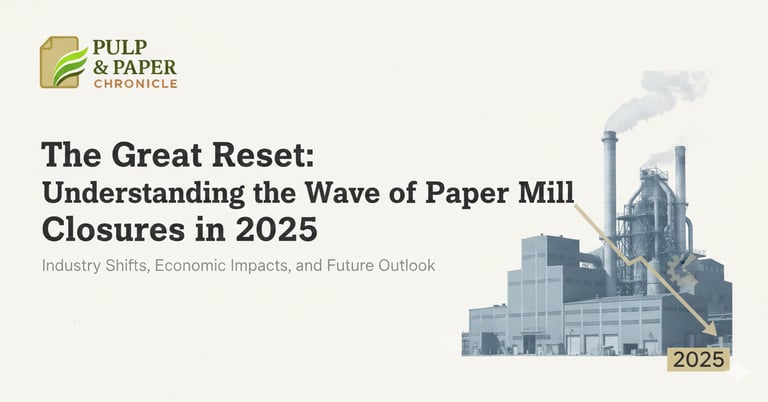
The announcement of Packaging Corporation of America's Wallula mill reconfiguration is not an isolated incident. It's part of a seismic shift reshaping the global paper and packaging industry. In 2025 alone, containerboard producers have eliminated approximately 9.5% of total North American production capacity—the most aggressive downsizing since the 2008-2009 financial crisis.
As someone who has followed this industry closely, I believe we're witnessing a fundamental transformation that will define the sector for the next decade.
The Perfect Storm: Five Forces Driving Mill Closures
1. Chronic Overcapacity
The industry has been suffering from structural overcapacity for years. Multiple producers cite rising costs and shifting demand as key factors behind their decisions. The market expanded aggressively post-pandemic to meet e-commerce demand, but that surge has normalized, leaving too many mills chasing too little business.
Industry analysts note that approximately 61% of corrugator respondents now anticipate containerboard prices will decline rather than increase, signaling persistent oversupply concerns.
2. The High-Cost Facility Problem
PCA's Wallula announcement reveals the brutal economics: the mill's wood fiber and power costs were the highest in their entire system. CEO Mark Kowlzan was direct—the configured mill was "no longer competitive." By consolidating to a single recycled fiber machine, they expect to reduce production costs by approximately $125 per ton.
This cost disparity isn't unique to Wallula. Companies across the industry are targeting aging assets that can't compete in today's environment.
3. Demand Deterioration
Box shipments have slowed significantly, with factors including slower retail sales, cautious inventory restocking, and normalization in online order volumes all contributing to softer demand. The containerboard sector is experiencing what one analyst called a "deterioration in corrugated markets."
The numbers tell the story: containerboard production decreased 3.1% in Q3 2025 compared with the same period in 2024, and total box shipments are projected to hit their lowest levels since 2015.
4. Global Trade Disruption
Tariff uncertainty and trade tensions have created additional headwinds. Ongoing tariff risks and weak manufacturing activity pose persistent challenges for box shipments and production. Export volumes have been particularly hard hit, declining nearly 12% in the first half of 2025.
5. Energy Cost Pressures
Rising energy expenses are making older, less efficient mills economically unviable. European mills face particularly acute challenges, while North American facilities in high-cost energy regions are being targeted for closure.
The Magnitude: A Comprehensive List of 2025 Closures
The 2025 closure wave spans three continents and affects all major paper grades:
North America - Containerboard:
International Paper (Multiple Facilities):
Campti, Louisiana (Red River containerboard mill) - 800,000 tons capacity, 674 employees (April 2025)
Savannah, Georgia (containerboard mill) - 1 million tons capacity, 691 employees (September 2025)
Riceboro, Georgia (containerboard mill) - 430,000 tons capacity, 300 employees (September 2025)
Supporting facilities in Phoenix (recycling), Hazleton PA (box plant), St. Louis (sheet feeder)
Georgia-Pacific:
Cedar Springs, Georgia - 535 employees (August 2025)
Packaging Corporation of America:
Wallula, Washington - 250,000 tons capacity reduction, 200 positions (Q1 2026)
North America - Newsprint/Specialty:
Kap Paper:
Kapuskasing, Ontario - 220,000 metric tons newsprint capacity, 420 employees (Idled September 2025, then partially restarted after government intervention in October)
Europe - Paper & Board:
Sappi:
Kirkniemi Mill, Finland (Paper Machine 2) - 175,000 tonnes coated mechanical paper, 93 positions (December 2025)
Alfeld Mill, Germany (PM1, PM4, Offline Coater 2, Sheet Finishing) - 180 positions (October 2025)
Metsä Board:
Tako Mill, Tampere, Finland - Board mill closure due to weakened demand and rising costs
UPM Communication Papers:
Ettringen, Germany - Closure by July 2025 to align capacity with profitable demand
Mondi:
Stambolijski, Bulgaria - 100,000 tonnes sack kraft paper, 300 employees (permanent closure after September 2024 fire)
Asia-Pacific:
Oji Fibre Solutions:
Kinleith Mill, Tokoroa, New Zealand (Paper Machine 6) - Loss-making paper line ceased operations by end of June 2025
Canada - Additional Forestry Sector Impacts:
Resolute Forest Products:
Maniwaki, Quebec sawmill - Temporary closure affecting 280 workers (September 2025)
Part of nine forestry plant closures across Quebec since April 2025
The Numbers: North American containerboard producers have collectively announced closures reducing production capacity by 3.9 million tons, approximately 9.5% of total capacity.
Since October 2024, International Paper alone has made closure announcements resulting in approximately 3,600 job cuts.
The Strategic Logic: Why This Makes Business Sense
Capacity Rationalization Drives Value
Industry forecasts project operating rates will climb from 90-91% to 95% by early 2026, creating tighter market conditions. This discipline should support pricing power and profitability for surviving mills.
Focus on Low-Cost Assets
Companies are redirecting production to their most efficient facilities. PCA, for instance, is investing in capacity enhancements at lower-cost mills like Jackson, which will bring 140,000 tons of high-performance, lightweight linerboard online in Q4 2026.
The "80/20" Optimization
International Paper's transformation under CEO Andy Silvernail exemplifies the new approach—focus on the 20% of assets that drive 80% of value. This ruthless prioritization means permanently closing marginal facilities rather than limping along.
European Structural Decline
Europe is experiencing its own reckoning. Sappi's closures reflect what executives call "wider structural changes in the paper market" and sustained financial challenges from declining demand across Europe.
What This Means for Stakeholders
For Employees and Communities
These closures represent devastating local economic impacts. From Kapuskasing to Campti, entire regions built around paper manufacturing must now diversify. The human cost—thousands of skilled workers displaced—cannot be understated.
The Kapuskasing case is particularly instructive: after the mill idled in September, community pressure and government intervention secured $30 million in combined federal-provincial support to enable a gradual restart, demonstrating that organized advocacy can sometimes change outcomes.
For Customers
Near-term: Potential supply tightness and price increases (analysts project $50/ton increases for kraftliner in early 2026)
Medium-term: More reliable pricing and improved service as producers operate leaner systems
For Investors
Companies demonstrating discipline in capacity management are positioning themselves for improved margins and returns. Analysts suggest this is "becoming an investable sector through the cycle."
For the Industry
This is creative destruction at work. The sector is becoming more rational, more efficient, and potentially more sustainable as older, less efficient mills are retired.
Looking Ahead: What to Watch in 2026-2027
Price Recovery: Projections indicate US East 42-lb kraftliner prices could rise $50 per ton in early 2026 and another $40 per ton in 2027, totaling $90/ton over two years.
Demand Recovery: Analysts forecast gradual improvement with average annual shipment growth of 1.6% in 2026-27.
Further Consolidation: Mega-mergers like Smurfit Kappa-WestRock signal continued M&A activity as companies seek scale advantages.
Global Dynamics: Asia is building significant new capacity, with global containerboard overcapacity estimated at roughly 22 million tonnes, potentially creating export pressures.
Government Intervention: The Kap Paper case shows governments are willing to step in for strategically important mills, suggesting future closures may involve more public-private negotiations.
Regional Impacts: The Full Picture
United States
The closures are concentrated in the South and Pacific Northwest, with Louisiana, Georgia, and Washington particularly affected. These regions are losing not just mills but entire industrial ecosystems built around forestry.
Canada
The newsprint sector faces existential challenges. Kap Paper's near-closure and subsequent rescue highlights how tariffs, changing media consumption, and energy costs are devastating traditional paper producers. Nine forestry plants closed in Quebec alone since April.
Europe
The situation is even more dire, with producers citing "structural decline in demand" and "sustained financial challenges." Finland and Germany are seeing multiple closures as digital transformation permanently reduces paper consumption.
The Bottom Line
The 2025 mill closure wave isn't a crisis—it's a necessary correction. For too long, the industry operated with excess capacity, depressed margins, and aging infrastructure. What we're witnessing is painful but productive rationalization.
Companies that emerge from this period will be leaner, more competitive, and better positioned to serve customers profitably. The mills shutting down aren't failures of workforce or management—they're casualties of structural change.
As PCA's Tom Hassfurther noted, "We remain committed to growing with our customers and will have sufficient containerboard capacity to do so."
The industry is being rebuilt for resilience, not just growth. That's the real story of 2025.