When the global pulp and paper industry moves, we report it first — trusted by 11,000+ subscribers across 85 countries

The Reusable Packaging Paradox: What McDonald's Data Reveals About Sustainability Trade-offs
MARKET ANALYSIS
Jino John
12/9/20253 min read
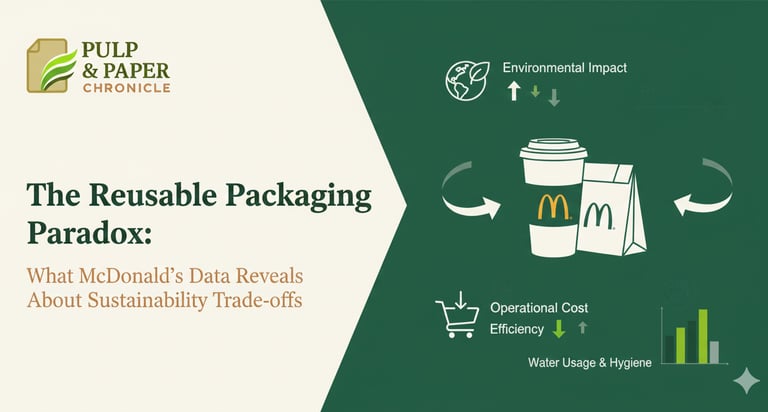
As Europe moves toward mandating reusable packaging in foodservice through regulations like the EU's Packaging and Packaging Waste Regulation (PPWR), a comprehensive new report from McDonald's reveals a complex reality that challenges conventional assumptions about sustainability.
The Core Findings
McDonald's recently published analysis of their reusable packaging implementation across France, Germany, and the Netherlands—based on real operational data from over 8,000 European restaurants—uncovers critical insights that every business leader and policymaker should understand.
The Numbers Tell a Surprising Story
When McDonald's modeled the EU PPWR requirement to offer 10% of takeout items in reusable packaging by 2030, the results were striking:
Plastic waste increased by 626% per restaurant annually
GHG emissions rose by 61% compared to fiber-based single-use packaging
Water consumption increased by 15%
These counterintuitive results stem from a fundamental challenge: achieving sufficient reuse rates to offset the environmental cost of producing and washing plastic reusables.
The Reuse Rate Challenge
The analysis reveals that customer behavior is the critical variable. For reusables to break even environmentally with McDonald's current fiber-based packaging:
Over 100 uses are needed to match plastic waste levels
18 uses are required to match GHG emissions
50 uses are needed for water consumption parity
Yet actual performance tells a different story:
In France (mandatory dine-in reusables): 33.9 uses achieved
In Netherlands (optional takeout): 1.5 uses achieved
In Germany (optional with €2 deposit): 2.6 uses achieved
Customer opt-in rates for optional reusables: less than 4%
Why This Matters Beyond McDonald's
This data has profound implications for the entire foodservice industry, which includes approximately 1.96 million enterprises across the EU:
1. Material Transitions Create New Trade-offs
McDonald's has invested heavily in transitioning to fiber-based packaging—96% in Europe is now fiber-based, with 95.2% sourced from renewable, recycled, or certified materials. Mandating a shift back to plastic reusables effectively reverses this progress on plastic reduction.
2. Infrastructure Determines Outcomes
The analysis demonstrates that recycling rates dramatically impact results. In Germany, McDonald's achieves a 92% recycling rate for fiber packaging collected in restaurants. If EU-wide fiber recycling improved from the assumed 3% to 30% for takeout, GHG emissions would drop by 8%—outperforming many reusable scenarios.
3. Operational Complexity Is Substantial
Implementing reusables requires:
Restaurant remodeling for washing and storage
New food safety protocols to prevent cross-contamination
Technology system updates across ordering platforms
Significant changes to customer experience
Substantial capital and operational cost increases
4. Water Impact Location Matters
While water consumption from production may decrease with reusables, water use shifts from Scandinavian production facilities to restaurant locations—including 30% of McDonald's EU restaurants in high water-stress regions.
The Path Forward: Evidence-Based Policy
McDonald's findings don't suggest abandoning sustainability efforts—rather, they highlight the need for evidence-based approaches that consider:
1. Customer Behavior Research First
Before mandating reusables, policymakers should invest in understanding what actually drives customer returns. Deposit schemes alone haven't proven sufficient.
2. Accelerated Recycling Infrastructure
The data shows that improving fiber recycling rates can deliver environmental benefits more reliably than low-performing reusable systems. Poland's example—where 95% of collected packaging is recycled through innovative contamination-handling technology—demonstrates what's possible.
3. Context-Specific Solutions
Dine-in reusables performed significantly better (33.9 uses) than takeout (1.5-2.6 uses). Regulations should reflect these operational realities rather than applying one-size-fits-all mandates.
4. Holistic Impact Assessment
Environmental analysis must consider the full picture: not just plastic reduction, but also GHG emissions, water consumption, water stress locations, and the realistic achievement of reuse rates.
Key Takeaways for Business Leaders
Sustainability is multidimensional: Solutions that solve one problem (plastic waste) may create others (GHG emissions, water stress).
Data beats assumptions: McDonald's serves 12 million customers daily in Europe. Their operational data on actual reuse rates should inform policy, not theoretical projections.
Material innovation matters: Continued investment in sustainable fiber alternatives, barrier coatings, and recycling technology may deliver more reliable environmental benefits than mandated reuse systems with low return rates.
Customer convenience influences environmental outcomes: Systems that ignore customer behavior patterns risk creating waste without environmental benefit.
Looking Ahead
As the EU PPWR takes effect with requirements for reusable takeout options by 2028 and a 10% reusable target by 2030, this analysis serves as a crucial reality check. The foodservice industry collectively serves hundreds of millions of customers daily—implementation challenges will be industry-wide, not unique to McDonald's.
The goal should be achieving actual environmental improvement, not simply checking a regulatory compliance box. This requires honest assessment of what's working, what isn't, and where to focus our collective sustainability efforts.
McDonald's conclusion bears repeating: "Before foodservice restaurant operators are compelled by law to make investments to implement reusable packaging and associated washing and return systems, evidence-based information about the effectiveness of reusable packaging in the sector should be taken into account."