When the global pulp and paper industry moves, we report it first — trusted by 10000 subscribers across 85 countries

US Paper & Packaging Industry Report (2026 Outlook) By Pulp & Paper Chronicle
MARKET ANALYSIS
Jino John
3/19/20263 min read
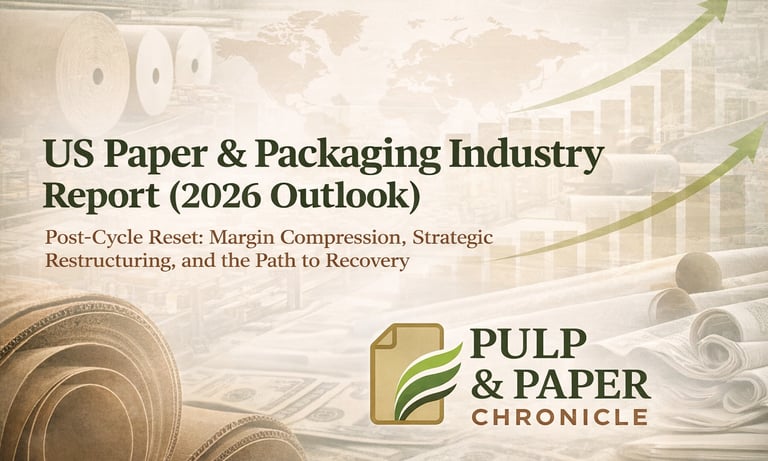
Post-Cycle Reset: Margin Compression, Strategic Restructuring, and the Path to Recovery
Executive Summary
The US paper and packaging industry concluded 2025 in a cyclical downturn marked by margin compression, subdued demand, and significant strategic repositioning across major players. However, entering 2026, the sector is transitioning toward early-stage recovery, driven primarily by cost optimization, portfolio restructuring, and disciplined capital allocation rather than a strong rebound in end-market demand.
This analysis is based primarily on Q4 2025 earnings releases, with selected companies also reporting full-year FY2025 results alongside quarterly disclosures. As such, it reflects the most recent available financial performance rather than a complete set of standalone annual reports across all companies.
Key findings from Pulp & Paper Chronicle analysis:
Earnings declined across much of the packaging value chain, with companies such as Graphic Packaging and Weyerhaeuser reporting significant EBITDA contraction due to weaker volumes and pricing pressure.
Clear divergence in performance has emerged:
Best-in-class operators (e.g., Packaging Corporation of America) sustained superior margins
Transformation-driven players (e.g., International Paper) are positioned for recovery
Mid-scale players (e.g., Clearwater Paper) face structural margin pressure
Strategic restructuring is reshaping the competitive landscape, including:
International Paper’s planned corporate separation
Smurfit WestRock integration
Portfolio simplification across Sonoco and others
2026 outlook is cautiously positive, with expected EBITDA growth driven by:
Cost-out initiatives
Operational efficiency gains
Gradual normalization of volumes
Market Definition & Coverage
This report evaluates the United States paper and packaging industry, with focus on:
Core Segments
Containerboard and corrugated packaging
Consumer paperboard packaging
Tissue and hygiene products
Industrial paper packaging
Timberlands and wood products
Companies Covered
International Paper
Smurfit WestRock
Packaging Corporation of America
Graphic Packaging
Sonoco
Kimberly-Clark
Clearwater Paper
Weyerhaeuser
Industry Overview (2025)
The US paper and paperboard sector remains a mature, consolidated industry:
Estimated total demand: 70–75 million tonnes
Packaging grades: ~60–65% of demand
Structural trends:
Packaging: steady growth
Tissue: stable and resilient
Printing & writing: structural decline
2025 Operating Environment
Volumes: flat to slightly negative
Pricing: mildly negative across packaging grades
Margins: compressed across most producers
Company Performance Analysis
International Paper – Transformation and Recovery Catalyst
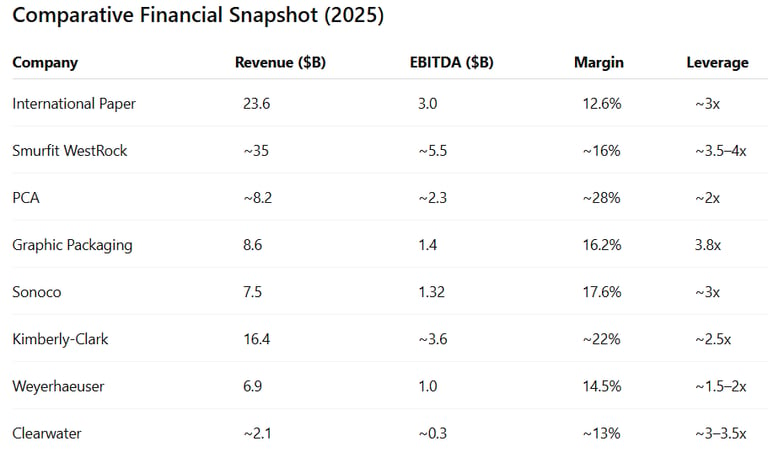
International Paper reported $23.6 billion in revenue and $3.0 billion in adjusted EBITDA in 2025, with reported losses driven by impairment and restructuring charges.
The company’s strategic shift toward two independent packaging businesses signals a major structural reset.
Pulp & Paper Chronicle View:
International Paper represents the strongest turnaround opportunity heading into 2026, supported by cost restructuring and portfolio focus.
Packaging Corporation of America – Operational Benchmark
PCA continues to demonstrate best-in-class execution, supported by:
Industry-leading EBITDA margins (~27–29%)
Strong vertical integration
Conservative leverage (~2x)
PCA sets the operational benchmark for North American containerboard producers.
Graphic Packaging – Margin Compression Under Pressure
Graphic Packaging reported:
Revenue: $8.6 billion (-2%)
EBITDA: down ~20% YoY
Margin decline from 19.1% to 16.2%
The company highlights the impact of weak pricing and cost inflation on mid-tier packaging players.
Sonoco – Growth Through Portfolio Expansion
Sonoco delivered strong top-line growth:
Revenue: $7.5 billion (+41.7%)
EBITDA: $1.32 billion (+27.9%)
Driven by acquisitions and productivity improvements.
Growth remains acquisition-led, with moderate organic momentum.
Kimberly-Clark – Defensive Margin Stability
Kimberly-Clark maintained:
Revenue: $16.4 billion
Organic growth: +1.7%
Strong margins supported by:
Brand strength
Productivity programs
Represents the most defensive earnings profile in the sector.
Clearwater Paper – Mid-Scale Structural Challenges
Clearwater operates in:
Bleached paperboard
Private label tissue
Facing:
Limited pricing power
Exposure to retail cost pressure
Mid-scale players remain structurally disadvantaged in the current cycle.
Weyerhaeuser – Cyclical Downturn Exposure
Weyerhaeuser reported:
Revenue: $6.9 billion
EBITDA decline from $1.3B to $1.0B
Driven by:
Weak housing demand
Lower lumber prices
Performance remains highly correlated to construction cycles.
Smurfit WestRock – Scale and Integration Strategy
Following its merger, Smurfit WestRock has emerged as the largest global packaging company, with focus on:
Synergies
Cost optimization
Portfolio integration
Execution of integration will determine long-term value creation.
Demand Drivers
E-commerce: long-term growth driver, short-term volatility
FMCG: stable but price-sensitive
Tissue & hygiene: resilient demand
Construction: key variable for wood products
Supply & Capacity Dynamics
Capacity rationalization (notably by IP)
Increased consolidation
Focus on:
Recycled fiber
Sustainable packaging
Higher-margin applications
Pricing & Cost Trends
Packaging prices declined modestly (~1%)
Fiber costs easing
Energy costs remain volatile
➡️ Net result: margin pressure in 2025
2026 Outlook
Base Case
Volume growth: +1–2%
Pricing: stable
EBITDA growth driven by cost savings
Upside Scenario
Strong demand rebound
Pricing recovery
Downside Scenario
Continued weak volumes
Persistent price pressure
Strategic Conclusions
2025 marked a cyclical trough for profitability
Recovery in 2026 will be gradual and cost-driven
Operational execution now outweighs scale advantages
Industry consolidation will continue to reshape competition
Pulp & Paper Chronicle – Strategic Takeaways
PCA remains the benchmark for operational excellence
International Paper offers the strongest turnaround potential
Kimberly-Clark provides defensive earnings stability
Mid-tier producers face ongoing structural margin pressure
Consolidation and restructuring will define the next cycle
Cost discipline will drive earnings recovery in 2026
The sector is entering early recovery—not full normalization
Prepared by:
Pulp & Paper Chronicle – Market Intelligence Division
March 2026