When the global pulp and paper industry moves, we report it first — trusted by 11,000+ subscribers across 85 countries

ABB's Pulp & Paper Business: Temporary Weakness Amid a Changing Market
MARKET ANALYSIS
Jino John
7/20/20263 min read

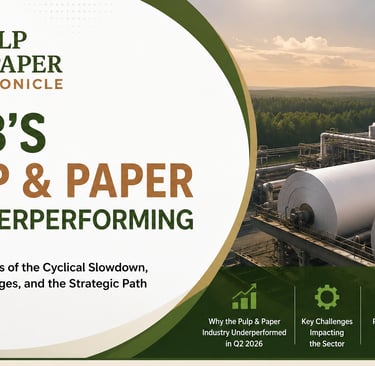
Why the Pulp & Paper Industry Underperformed in Q2 2026
Introduction
Pulp and paper's current softness is a cyclical downturn, not a structural one. ABB's Q2 2026 results, reported July 16, make the split clear: total orders hit a record $12.0 billion, up 30% on a comparable basis, driven by data centers, grid modernization, marine, and electrification. Against that backdrop, management flagged pulp & paper — alongside chemicals and mining — as one of the few segments still running soft. The question for ABB isn't whether the sector recovers, but how it wins share while producers stay in cash-preservation mode.
Why the Sector Is Underperforming
The weakness traces to a few reinforcing pressures rather than one cause. Capital discipline is the most visible: with pulp prices volatile and margins tight, producers are prioritizing balance-sheet preservation over new production lines or greenfield mills, favoring maintenance and cost reduction instead. That caution is compounded by structurally high input costs — electricity, steam, chemicals, fiber, and labor all remain expensive, leaving less room for management teams to justify long-cycle bets.
Underneath that is a maturity problem: pulp and paper isn't a capacity-expansion story in most developed markets anymore, so investment naturally skews toward modernization and efficiency rather than new build. Demand itself is also splitting. Printing, writing, and newsprint grades are in structural decline, while packaging, containerboard, tissue, and specialty/sustainable fiber products are growing — and mills still tied to declining grades are delaying capital decisions until they settle on long-term positioning. Layer on macro drag (rate levels, inflation, soft industrial output, geopolitical risk) and capital simply gets reallocated: investors and even internal capital committees are chasing data centers, grid infrastructure, renewables, and AI-linked electrification instead, where growth is faster and more visible.
None of this argues for structural decline, though. E-commerce packaging growth, plastic substitution, rising tissue demand, and decarbonization mandates are all demand tailwinds that are evolving in form, not disappearing.
What Producers Need to Do
The response doesn't require producers to wait for capex cycles to turn. Digitizing aging control systems — advanced process control, digital twins, remote operations, predictive maintenance — cuts cost without a new mill. Energy efficiency (high-efficiency motors, variable-speed drives, digital power monitoring) is the fastest-payback lever available in an energy-intensive industry, and it doubles as a sustainability win. Modernizing existing assets — drive replacements, control upgrades, electrification retrofits — delivers most of the productivity gain of a new line at a fraction of the capital outlay, and automation additionally offsets a real labor problem as experienced operators retire and skilled replacements are hard to find. Sustainability itself has stopped being a compliance line item and is increasingly a competitive differentiator in customer and financing decisions.
Strategic Recommendations for ABB
● Shift the revenue mix toward lifecycle services. As large capital projects get deferred, ABB should lean into maintenance contracts, remote monitoring, predictive maintenance, and digital optimization — lower risk for the customer, more stable and higher-margin for ABB.
● Sell energy efficiency as a financial case, not a technology pitch. Quantify payback periods, opex reduction, and carbon impact for motors, drives, and electrification systems rather than leading with specifications.
● Push AI-driven automation as the differentiator. Intelligent process control that measurably improves stability, energy use, and unplanned downtime is where ABB can win against price-only competitors.
● Concentrate on the growing grades. Packaging, tissue, specialty, and bio-based papers are where investment momentum is holding up — that's where sales effort should be weighted, rather than spreading thin across the whole sector.
● Monetize the installed base. ABB's existing footprint across global mills is itself a pipeline — modernization, software upgrades, and asset performance management can generate revenue without waiting for greenfield decisions to return.
Bottom Line
Pulp and paper's weakness is a function of deferred discretionary spending, not eroding demand. The long-term drivers — sustainable packaging, decarbonization, electrification, digital manufacturing — are intact. ABB doesn't need a capex rebound to grow here; it needs to capture the modernization, efficiency, and lifecycle-service spend that's happening instead of new builds, positioning itself to move fast when large-project spending does return.