When the global pulp and paper industry moves, we report it first — trusted by 10000 subscribers across 85 countries

Amazon's €17 Billion Low-Carbon Investment: A Structural Turning Point for Europe's Paper & Packaging Industry
MARKET ANALYSIS
Jino John
6/25/20264 min read
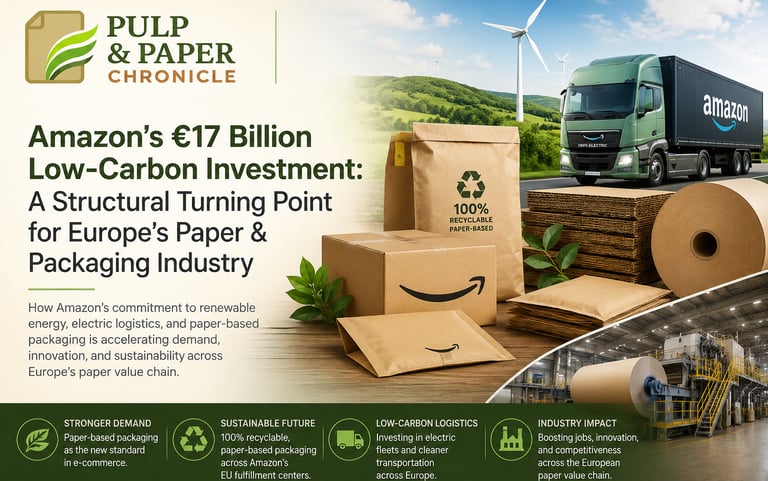
Amazon's €17 billion investment is not simply an environmental initiative—it represents a major demand signal for Europe's paper and packaging value chain. As sustainability becomes embedded in procurement and logistics strategies, the transition toward recyclable fiber-based packaging is creating new opportunities for paper manufacturers, converters, and packaging technology providers.
While headlines naturally focus on renewable energy, electric vehicles, and logistics decarbonization, the most significant implication for the paper industry lies in Amazon's commitment to paper-based packaging, recyclable materials, lightweight designs, and supply-chain optimization. These initiatives are reshaping demand across the value chain—from virgin kraft producers and recycled fiber mills to packaging converters and machinery suppliers.
The End of Single-Use Plastic Is Becoming a Commercial Reality
Perhaps the most consequential development is Amazon's confirmation that 100% of packaging used in its European fulfillment centers has been recyclable and paper-based since 2022.
For years, regulators drove the transition away from plastic through legislation such as the EU Single-Use Plastics Directive. Amazon's announcement demonstrates that market forces are now accelerating the same transition.
Unlike regulatory mandates, demand from one of the world's largest e-commerce companies creates long-term purchasing certainty for packaging suppliers. This fundamentally changes investment decisions throughout the paper industry.
The shift validates years of capacity investments in:
Containerboard
Corrugated packaging
Paper mailers
Molded fiber packaging
Lightweight kraft papers
Specialty recyclable packaging grades
Demand Signal for European Paper Manufacturers
The report specifically highlights Amazon's collaboration with companies including DS Smith, Mondi, and Novamont.
These partnerships illustrate an important market trend.
Large global retailers are increasingly moving away from transactional purchasing toward strategic supplier ecosystems capable of delivering:
Sustainable fiber sourcing
Packaging innovation
Lifecycle carbon reduction
Digital traceability
Circular economy compliance
For European paper producers, this creates higher barriers to entry but also stronger long-term customer relationships.
Packaging Optimization Is Becoming More Valuable Than Packaging Volume
One of the most overlooked findings in Amazon's report is the deployment of over 70 automated packaging machines that have reduced average packaging weight by more than 26 grams per shipment, while AI-driven sizing has reduced cardboard consumption by more than 35% over five years.
At first glance, reduced fiber usage may appear negative for paper demand.
In reality, it reflects a broader industry transformation.
Historically, packaging suppliers competed primarily on production volume. Increasingly, competitive advantage comes from engineering expertise, material efficiency, automation compatibility, and packaging performance.
The future market rewards suppliers capable of delivering "less material with higher protection."
Consequently, value creation shifts toward innovation rather than tonnage.
Why Corrugated Packaging Demand Remains Strong
Despite material reduction initiatives, e-commerce continues to support structural growth in corrugated packaging.
Several factors explain this:
Continued expansion of online retail
Replacement of plastic mailers with paper alternatives
Increasing adoption of right-sized packaging
Growth in recyclable paper envelopes
Expansion of same-day delivery networks
While individual packages contain less paper, the overall number of shipments continues to increase.
This creates steady underlying demand for containerboard and converted packaging products, even as packaging efficiency improves.
Renewable Energy Is Quietly Improving Paper Industry Economics
Amazon's investment in over 120 renewable energy projects, totaling more than 8.7 GW of carbon-free capacity, carries indirect significance for Europe's pulp and paper industry.
Paper manufacturing remains one of Europe's most energy-intensive industrial sectors.
Long-term expansion of renewable electricity has the potential to:
Reduce energy price volatility
Improve electricity availability
Lower Scope 2 emissions
Support electrification of paper mills
Improve competitiveness against imported paper products
Although Amazon is not investing directly in paper production, its power purchase agreements contribute to a broader energy ecosystem that benefits industrial manufacturing.
Supply Chain Decarbonization Creates New Competitive Standards
Amazon's logistics investments—including electric delivery fleets, electric heavy trucks, and charging infrastructure—will increasingly influence supplier requirements.
Packaging suppliers seeking preferred vendor status are likely to face higher expectations regarding:
Carbon accounting
Renewable energy usage
Transportation emissions
Certified fiber sourcing
Circular packaging performance
Sustainability is no longer simply a marketing advantage.
It is becoming a prerequisite for participation in major procurement programs.
Automation Will Separate Industry Leaders From Followers
The report highlights AI-driven packaging optimization, automated packaging machines, and custom computing technologies.
For paper converters, automation is emerging as a decisive competitive factor.
Future investment priorities are likely to include:
AI-assisted box optimization
Automated converting lines
Digital printing
Robotics
Smart warehouse integration
Predictive production planning
The competitive landscape increasingly favors manufacturers capable of integrating digital technologies with traditional converting operations.
Circular Economy Becomes a Commercial Strategy
Amazon's emphasis on recyclable packaging reflects a broader transition from linear production models to circular material systems.
For the paper industry, this strengthens demand for:
Recycled containerboard
High-quality recovered fiber
Closed-loop recycling systems
Fiber recovery technologies
Sustainable forestry certification
Companies capable of maximizing fiber recovery while maintaining packaging performance are likely to capture disproportionate market growth.
Implications for Global Paper Markets
Although the investments focus on Europe, their influence extends globally.
International e-commerce companies often standardize packaging practices across regions once operational success has been demonstrated.
Markets likely to experience similar transitions include:
North America
India
Southeast Asia
Latin America
Packaging innovations proven in Europe frequently become global operating standards.
Investment Outlook
Amazon's announcement reinforces several long-term investment themes within the paper and packaging sector:
Positive Outlook
Containerboard
Corrugated packaging
Paper mailers
Molded fiber packaging
Sustainable packaging machinery
Packaging automation
Fiber recycling technologies
Neutral Outlook
Traditional printing papers
Commodity kraft grade
Challenged Segments
Plastic e-commerce mailers
Mixed-material packaging
Difficult-to-recycle laminates
Single-use flexible plastics
Conclusion
Amazon's €17 billion investment should not be viewed solely as a sustainability initiative.
From a paper industry perspective, it represents another milestone in the structural evolution of packaging demand.
The market is moving beyond simply replacing plastic with paper. The next phase centers on intelligent fiber utilization—lighter packaging, AI-driven optimization, renewable-powered manufacturing, circular material flows, and digitally integrated supply chains.
For paper manufacturers, converters, and packaging innovators, the message is clear: future growth will depend less on producing more paper and more on producing smarter, lower-carbon, high-performance packaging solutions.
The companies best positioned for the coming decade will be those that combine sustainability, automation, engineering capability, and circular economy principles into a single competitive offering. Amazon's latest investment demonstrates that these trends are no longer aspirational—they are becoming the operating model of Europe's next-generation packaging economy.