When the global pulp and paper industry moves, we report it first — trusted by 10000 subscribers across 85 countries

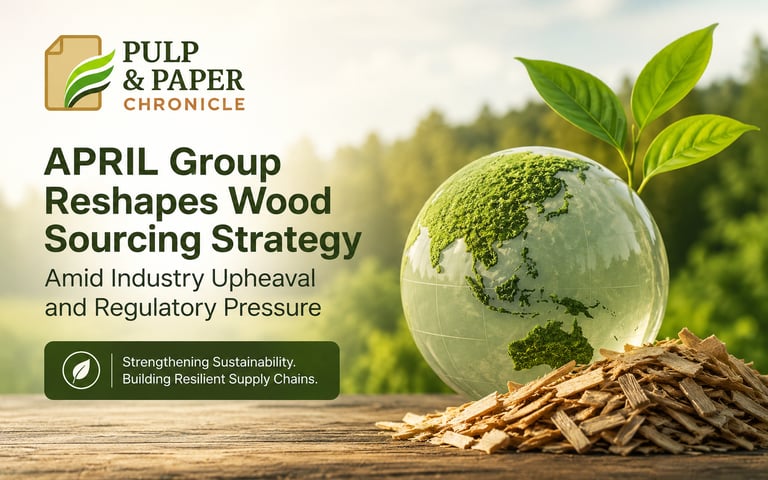
APRIL Group Reshapes Wood Sourcing Strategy Amid Industry Upheaval and Regulatory Pressure
MARKET ANALYSIS
Jino John
6/20/20263 min read
Forestry giant updates sustainability framework while navigating major supply chain disruptions
APRIL Group is overhauling its wood sourcing strategy at a time when the global forestry sector is facing unprecedented scrutiny over deforestation, traceability, and supply chain resilience.
The company has announced a comprehensive update to its Sustainable Forest Management Policy (SFMP 2.0), reinforcing its commitment to responsible fibre sourcing while adapting to evolving international regulations and unexpected disruptions within Indonesia's forestry sector.
The review comes at a pivotal moment for the pulp and paper industry, as regulators, investors, customers, and environmental groups demand stronger accountability across forest-product supply chains.
A New Compliance Threshold
At the centre of the revision is a new deforestation and land-conversion cut-off date of 31 December 2020, aligning APRIL's sourcing framework with major global standards, including the EU Deforestation Regulation (EUDR), the Accountability Framework Initiative (AFi), and the Forest Stewardship Council (FSC).
The move is more than a technical adjustment. It represents APRIL's effort to position itself for a future in which market access increasingly depends on verifiable sustainability credentials.
Under the updated framework, fibre sourced from land converted before the 2020 cut-off date may still be accepted, provided suppliers comply with APRIL's Wood and Fibre Sourcing Policy and can demonstrate full traceability down to the plantation compartment level.
APRIL says its Sustainability Policy, Human Rights Policy, and Wood and Fibre Sourcing Policy remain fully in force throughout the review process, continuing to prohibit deforestation and unacceptable land conversion across its operations and supply chain.
For customers facing growing regulatory obligations of their own, maintaining uninterrupted compliance throughout a policy transition is becoming an increasingly important requirement.
A Supply Shock Tests the System
The policy review follows one of the most significant disruptions to Indonesia's forestry sector in recent years.
In January 2026, Indonesian authorities revoked operating permits for 28 forestry companies, including four long-term fibre suppliers that formed part of APRIL's sourcing network.
The decision created an immediate procurement challenge and highlighted a growing reality for natural-resource industries: sustainability commitments alone are no longer enough. Supply chains must also be resilient to regulatory and political shocks.
To address the shortfall, APRIL moved quickly to diversify its sourcing base, onboarding new suppliers from the open market after conducting environmental, social, and governance (ESG) due diligence assessments.
New Suppliers, New Questions
Among the suppliers entering APRIL's network is PT Industrial Forest Plantation (PT IFP), which has already begun supplying fibre from plantation compartments that meet APRIL's updated sourcing requirements.
Another supplier, PT Mayawana Persada (PT MWP), is expected to join the network after completing a similar evaluation process.
However, the additions have attracted scrutiny.
Both companies have previously faced criticism from environmental organisations regarding deforestation concerns, raising questions about whether suppliers with contested environmental histories can credibly participate in sustainability-focused supply chains.
APRIL's position is that engagement creates stronger outcomes than exclusion.
The company argues that bringing suppliers into a framework governed by strict sustainability requirements, independent audits, and ongoing monitoring provides a pathway toward improved environmental performance.
Critics counter that credibility will depend not on commitments made today, but on measurable outcomes delivered in the years ahead.
Raising the Bar for Supplier Accountability
To participate in APRIL's supply chain, suppliers must commit to a range of environmental and social obligations, including:
A permanent halt to deforestation and land conversion.
Identification and protection of conservation areas within concession boundaries.
Active conservation and ecological restoration programmes.
Community engagement and social responsibility initiatives.
Independent audits and ongoing third-party verification.
Monthly land-cover monitoring using satellite-based analytical systems.
Both PT IFP and PT MWP have formally adopted no-deforestation commitments and agreed to align their operations with APRIL's sustainability requirements.
Whether those commitments translate into lasting change will depend on consistent monitoring, transparent reporting, and independent verification.
An Industry in Transition
APRIL's policy overhaul reflects a broader transformation underway across the global forestry sector.
As governments tighten regulations and investors place greater emphasis on environmental performance, companies are rethinking how they manage sourcing, traceability, and supplier oversight.
Regulations such as the EUDR are accelerating demand for systems capable of tracking the origin of every shipment of fibre and proving compliance throughout the supply chain.
In this environment, sustainability has evolved from a corporate responsibility initiative into a strategic business requirement directly linked to market access, investor confidence, and long-term competitiveness.
Looking Toward APRIL2030
APRIL says the policy review supports its broader APRIL2030 commitments focused on climate action, nature conservation, and inclusive development.
The company also continues to engage with FSC International as part of its ongoing remedy process, a key step in rebuilding trust and strengthening alignment with globally recognised forestry standards.
As the forestry sector enters a new era of heightened accountability, APRIL's evolving sourcing strategy will be closely watched by regulators, customers, investors, and environmental stakeholders alike.
The next 12 to 18 months may ultimately determine whether the policy update becomes a model for balancing sustainability and supply security—or another test of how difficult it is to reconcile commercial realities with environmental expectations.