When the global pulp and paper industry moves, we report it first — trusted by 10000 subscribers across 85 countries

China Paper and Paperboard Industry Production Report January–March 2026
MARKET ANALYSIS
Jino John
6/18/20263 min read
Overview
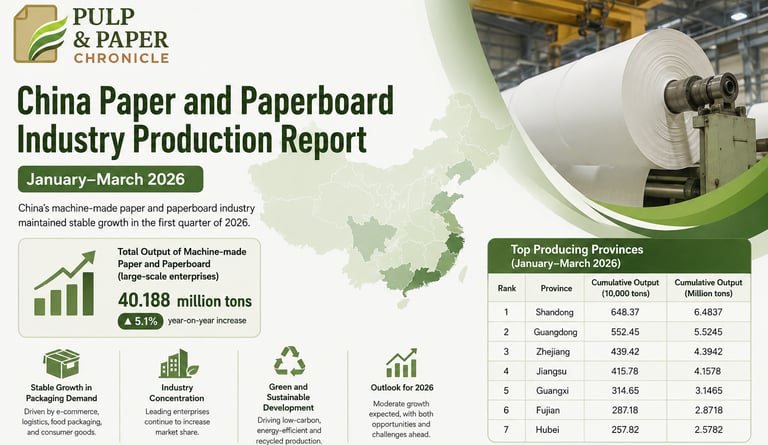
According to data released by the National Bureau of Statistics of China, China’s machine-made paper and paperboard industry maintained stable growth in the first quarter of 2026. From January to March 2026, the total output of machine-made paper and paperboard (excluding processing of purchased raw paper) by large-scale enterprises nationwide reached 40.188 million tons, representing a year-on-year increase of 5.1%.
The data reflects continued recovery in industrial demand, expanding packaging consumption, and stable growth in downstream sectors such as e-commerce, logistics, food packaging, and consumer goods manufacturing.
National Production Performance
China’s paper and paperboard production remained highly concentrated in coastal and manufacturing-intensive provinces. Eastern and southern provinces continued to dominate national output due to advantages in industrial clusters, export-oriented manufacturing, transportation infrastructure, and access to raw materials.
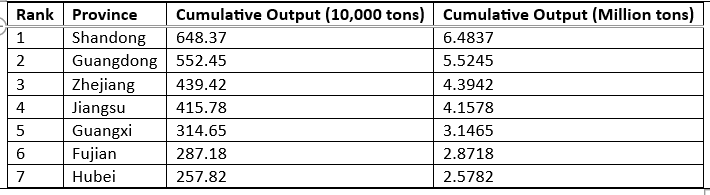
Top Producing Provinces (January–March 2026)
Together, the top four provinces accounted for more than half of national production, highlighting the strong regional concentration of China’s paper manufacturing industry.
Regional Analysis
1. Shandong Province Leads the Nation
Shandong Province ranked first nationwide with a cumulative output of 6.4837 million tons during the first quarter of 2026.
Key advantages supporting Shandong’s leadership include:
Strong industrial foundation in papermaking
Large-scale integrated paper enterprises
Well-developed logistics and port infrastructure
High concentration of packaging and export manufacturing industries
Stable domestic and overseas demand
Shandong has long been one of China’s core papermaking bases, particularly in packaging paper, containerboard, and industrial paper products.
2. Guangdong Maintains Strong Production Capacity
Guangdong Province ranked second with 5.5245 million tons of output.
As China’s largest manufacturing and export province, Guangdong benefits from:
Massive packaging demand from export industries
Strong e-commerce and consumer goods sectors
Advanced supply chains
High concentration of downstream converting enterprises
The province remains a major driver of packaging paper consumption and production growth.
3. Zhejiang and Jiangsu Form the Yangtze River Delta Production Hub
Zhejiang and Jiangsu together produced over 8.55 million tons during the quarter.
The Yangtze River Delta region continues to serve as one of China’s most advanced paper manufacturing clusters due to:
High industrial efficiency
Strong environmental compliance capabilities
Mature recycling systems
Advanced papermaking technologies
These provinces are particularly competitive in high-grade packaging paper and specialty paper production.
4. Guangxi Emerges as a Key Southern Production Base
Guangxi Zhuang Autonomous Region produced 3.1465 million tons, ranking fifth nationally.
The region has become increasingly important because of:
Rich forestry and pulp resources
Lower operating costs
Expansion of integrated pulp-and-paper projects
Policy support for industrial development
Guangxi is gradually strengthening its role in China’s pulp supply chain and integrated papermaking capacity.
Industry Trends
Stable Growth in Packaging Demand
The 5.1% year-on-year increase indicates resilient demand from:
E-commerce packaging
Food and beverage packaging
Consumer goods
Logistics and transportation industries
Containerboard and corrugated paper remain major growth drivers.
Continued Industry Concentration
Production remains concentrated among large-scale enterprises and developed industrial regions. Smaller producers continue facing pressure from:
Environmental compliance costs
Energy efficiency requirements
Raw material price volatility
Industry consolidation
Leading enterprises are expected to further increase market share.
Green and Sustainable Development
China’s paper industry continues transitioning toward:
Energy-efficient production
Low-carbon manufacturing
Recycled fiber utilization
Cleaner pulping technologies
Environmental regulations are accelerating modernization across the sector.
Outlook for 2026
Looking ahead, China’s paper and paperboard industry is expected to maintain moderate growth throughout 2026, supported by:
Stable domestic consumption
Recovery in industrial production
Expansion of e-commerce logistics
Ongoing urban consumption upgrades
However, the industry may still face challenges including:
Fluctuating pulp prices
International trade uncertainties
Environmental policy tightening
Energy cost pressures
Large integrated producers with strong supply chains and technological advantages are likely to continue outperforming the broader market.
Conclusion
China’s machine-made paper and paperboard industry achieved solid growth in the first quarter of 2026, with total national output reaching 40.188 million tons, up 5.1% year-on-year. Shandong Province maintained its leading position with output exceeding 6.48 million tons, followed by Guangdong, Zhejiang, and Jiangsu.
The data demonstrates continued resilience in China’s manufacturing and packaging sectors, while also highlighting the increasing concentration, modernization, and sustainability transformation of the country’s paper industry.