When the global pulp and paper industry moves, we report it first — trusted by 11,000+ subscribers across 85 countries

Finch Paper's Exit from Pulp Manufacturing: Strategic Rationale, Market Context, and Northeast Forest-Economy Impact
MARKET ANALYSIS
Jino John
7/23/20266 min read
Summary
Finch Paper, the 161-year-old Glens Falls, New York manufacturer, announced on July 17, 2026 that it will permanently discontinue sulfite pulp production and source 100% of its pulp requirements from external suppliers, most likely Canadian producers and the open-market (“market pulp”) system. The company frames the move as a strategic simplification: an “eight-figure” capital investment in receiving and processing purchased pulp, paired with paper-machine and energy upgrades, is intended to sharpen Finch's focus on paper manufacturing and expand its product range. Biomass cogeneration operations, which run on bark, sawdust, and mill residuals rather than roundwood, will continue.
The decision effectively removes one of only two remaining pulpwood markets in eastern New York, leaving Sylvamo's former International Paper facility in Ticonderoga as the sole major regional buyer of low-grade wood. The Professional Logging Contractors of the Northeast (PLC) estimates the change will materially compress demand across a logging and trucking sector that has already absorbed a 40% reduction in wood markets over the past five years, and warns of secondary effects on forest-health practices such as selective thinning that depend on a viable low-grade wood outlet.
Bottom line for operators and policymakers: this is a supply-side consolidation event, not an isolated plant closure — it removes marginal demand from an already thin, geographically concentrated buyer pool and raises the strategic value of remaining outlets (Sylvamo Ticonderoga, biomass/bioenergy markets, and out-of-region pulp mills).
2. What Happened
Finch Paper (part of Finch Holdings, owned by private-equity firm Atlas Holdings) will stop producing pulp on-site — a process that historically supplied roughly 80% of the mill's pulp needs, with about 20% already purchased externally — and will instead buy the full volume on the open market. The company will stop purchasing the large-diameter pulpwood logs it has historically sourced from independent logging contractors across New York, Vermont, New Hampshire and the wider Northeast; roughly 45–50 log trucks arrived at the mill daily under the prior model. Wood purchasing for the biomass cogeneration facility — bark, sawdust, and rejected wood scraps used to generate high-pressure steam — will continue unaffected.
All hourly pulp-mill and woodyard employees are being offered transfer opportunities elsewhere in the company, and affected salaried staff will be considered for open positions, suggesting Finch intends to manage the transition primarily through redeployment rather than broad layoffs, though the ultimate headcount impact will depend on how many transfer offers are accepted and how many equivalent roles exist.
3. Strategic Rationale: Why This Makes Sense for Finch
Independent of the impact on the region, the logic of the decision is consistent with well-worn playbooks in mature manufacturing: vertical de-integration to concentrate capital and management attention on the higher-margin, brand-differentiated end of the value chain.
Capital reallocation: sulfite pulping is capital- and maintenance-intensive (recovery boilers, digesters, causticizing) with limited differentiation value; redirecting an eight-figure investment toward paper-machine upgrades and purchased-pulp handling infrastructure targets the part of the business where Finch actually competes on product and brand.
Cost and flexibility: Global market pulp pricing has been volatile but persistently available at scale from low-cost Canadian and southern U.S./South American producers; buying pulp lets Finch flex volume and species/furnish mix without carrying fixed pulping costs through demand cycles.
Demand-side pressure: Industry-wide, U.S. printing-writing paper shipments fell roughly 8% year-over-year in June 2026 per the American Forest & Paper Association (AF&PA), while packaging paper shipments rose about 2% — a structural backdrop that rewards agility and expanded product offerings over captive raw-material integration.
Ownership context: Atlas Holdings' broader portfolio moves (including its 2025 take-private acquisition of Office Depot/OfficeMax's parent) are consistent with a private-equity approach favoring operational simplification and margin-focused restructuring across portfolio companies.
Reading between the lines, Finch is optimizing at the firm level for resilience and margin in a shrinking segment of paper demand — a rational, arguably necessary decision from a corporate-finance perspective. The externality is that the mill's pulpwood purchasing was, in effect, subsidizing a regional forest-products ecosystem well beyond what Finch's own paper business required.
4. Regional Market Structure: Why This Outlet Mattered
Eastern New York's low-grade pulpwood market was already thin. PLC identifies the Glens Falls mill as one of only two pulp markets in the sub-region purchasing from contractors across multiple Northeastern states; Sylvamo's Ticonderoga facility is now understood to be the last major buyer of scale in eastern New York. Low-grade wood — material unsuitable for sawlogs — has no viable alternative outlet in most of this geography besides pulp mills and, at smaller volumes, biomass energy facilities.
This matters beyond direct mill revenue because pulpwood markets are the economic mechanism that makes selective thinning and other forest-health silviculture financially viable for landowners and loggers. Without a buyer for the low-grade material removed during thinning operations, the economics of many stand-improvement harvests deteriorate, with knock-on effects for wildfire risk, forest resilience, and long-term timber quality across the region's private and public forestland.
5. Stakeholder Impact Assessment
5.1 Independent logging and trucking contractors
This group carries the most direct and immediate exposure. Contractors who supplied Finch will face some combination of longer haul distances to Ticonderoga (compressing already-thin trucking margins), reduced harvest volumes where low-grade wood can no longer be economically moved, and downward pressure on stumpage prices as competition for the remaining buyer intensifies. Given the 40% five-year decline in wood markets PLC already reports, this is a compounding — not a standalone — shock.
5.2 Private and institutional landowners
Reduced markets for low-grade wood raise the cost of forest-management harvests (thinning, salvage, improvement cuts), which may lead some landowners to defer silviculture, shift toward high-grading (removing only the most valuable timber, to the long-term detriment of stand quality), or explore alternative land uses, including conversion pressure in some parcels.
5.3 Finch employees
The company's redeployment-first approach (transfer offers for hourly staff, consideration for salaried staff) suggests a managed transition rather than a simple layoff event, but actual job security will hinge on the number of equivalent openings elsewhere in the business and the willingness/ability of pulp-mill and woodyard staff to relocate or retrain into paper-side roles.
5.4 Sylvamo (Ticonderoga) and remaining buyers
As the last major eastern New York outlet, Sylvamo gains outsized market power and could see increased log-supply offers, but also faces the operational question of whether its intake capacity and species/quality specifications can absorb a meaningful share of Finch's former volume without its own bottlenecks or price adjustments.
5.5 Biomass and bioenergy operators
Facilities that use residuals and low-grade wood for energy generation, including Finch's own cogeneration plant, become relatively more important outlets, though they typically cannot absorb the same volumes or pay comparable prices to a pulp mill for equivalent material.
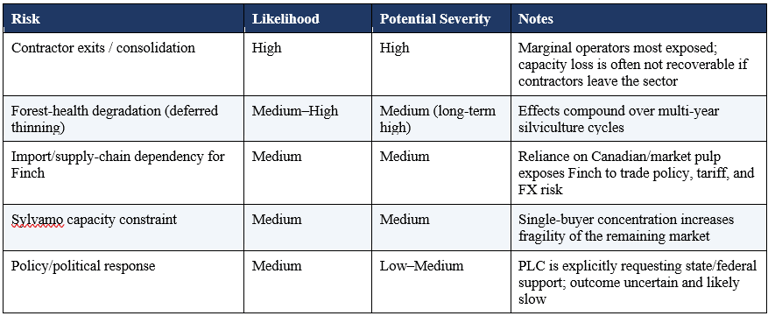
6. Risk Analysis
7. Outlook and Scenarios
Base case (60%): Finch proceeds as announced; regional wood markets tighten further, some contractor attrition occurs, and Sylvamo absorbs a partial but incomplete share of displaced volume. Stumpage prices for low-grade wood soften in eastern New York and western Vermont/New Hampshire.
Reversal scenario (15%): Per PLC Executive Director Dana Doran, Finch has left the door open to resuming in-house sulfite pulp production if global pulp pricing conditions make internal production cheaper than purchasing — a scenario tied to pulp-market cyclicality more than sentiment.
Policy-mitigated scenario (25%): State and/or federal support (e.g., market-development funding, biomass incentives, trucking/logging support programs) partially offsets the demand loss, though PLC's ask for such support has not yet been met with a defined program.
8. Recommendations
8.1 For logging and trucking contractors
Model route economics to Sylvamo/Ticonderoga now, including fuel, distance, and backhaul, to identify which harvest blocks remain viable versus which become marginal.
Explore diversification into biomass/bioenergy supply contracts and out-of-region pulp buyers as partial hedges, recognizing these are unlikely to fully replace lost volume.
8.2 For landowners and forest managers
Prioritize thinning and improvement harvests on a shorter timeline while any residual market access exists, rather than deferring and risking further market erosion.
8.3 For state and regional policymakers
Evaluate targeted support for wood-market development (e.g., biomass energy incentives, value-added processing investment) rather than only transportation subsidies, since the underlying issue is a demand-side gap, not solely a logistics cost.
8.4 For Finch Paper
Given the reputational and community stakes highlighted by PLC and local coverage, transparent, proactive communication with the contractor base about the sourcing transition timeline would reduce disruption and preserve regional goodwill for a 161-year-old anchor employer.