When the global pulp and paper industry moves, we report it first — trusted by 11,000+ subscribers across 85 countries

Green Solutions Create Room for Sustainable Growth in Vietnam’s Paper Industry
MARKET ANALYSIS
Jino John
7/27/20263 min read
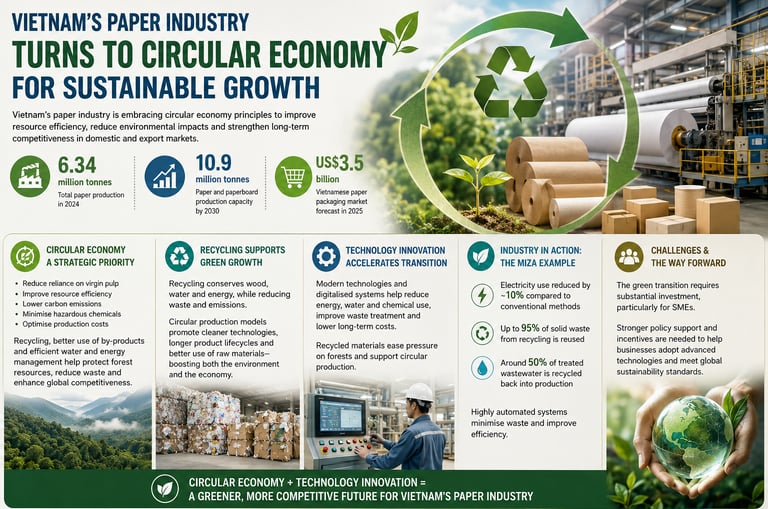
Vietnam’s paper industry is increasingly embracing circular economy principles as manufacturers seek to improve resource efficiency, reduce environmental impacts and strengthen long-term competitiveness in both domestic and export markets.
The paper and pulp industry remains a vital contributor to the global economy, supplying packaging, printing and a broad range of consumer products. In Vietnam, the sector has recorded sustained double-digit annual growth over the past decade, with total paper production estimated at 6.34 million tonnes last year. Industry projections indicate that paper and paperboard production capacity could reach 10.9 million tonnes by 2030.
Growth is also being supported by rising demand for sustainable packaging. The Vietnamese paper packaging market is forecast to reach US$3.5 billion this year, driven by the continued expansion of e-commerce and the increasing shift away from plastic packaging.
Circular Economy Becomes a Strategic Priority
As sustainability expectations continue to rise, paper manufacturers face growing pressure to reduce dependence on virgin pulp, improve resource efficiency and lower carbon emissions. Companies are also being encouraged to minimise the use of hazardous chemicals while optimising production costs and operational performance.
Industry experts believe that adopting circular economy practices offers a practical pathway to address these challenges. By expanding paper collection and recycling systems, improving the utilisation of production by-products and managing water and energy more efficiently, manufacturers can reduce pressure on forest resources while lowering waste generation and greenhouse gas emissions.
Beyond environmental benefits, these initiatives can help businesses reduce production costs, improve material efficiency and strengthen their competitive position in international markets, where sustainability and carbon reduction requirements are becoming increasingly stringent.
Recycling Supports Green Growth
According to Cao Văn Sơn, Director of the Research Institute of Pulp and Paper Industry (RIPPI) under Vietnam’s Ministry of Industry and Trade, circular economy development is becoming an essential component of the industry's long-term strategy.
Speaking to Công Thương (Industry and Trade) Newspaper, Sơn said paper recycling enables manufacturers to conserve wood, water and energy while reducing solid waste and pollutant emissions. He added that circular production models encourage companies to adopt cleaner technologies, extend product lifecycles and optimise raw material use, helping lower production costs and improve competitiveness.
He noted that the approach supports both economic growth and environmental protection while responding to increasing consumer demand for environmentally responsible products.
“Circular economy development is an inevitable solution for the paper industry to achieve green and sustainable growth goals,” Sơn said.
Technology Innovation Accelerates the Transition
Industry specialists also emphasise that achieving sustainability targets will require greater investment in modern manufacturing technologies, digitalised production systems and environmental, social and governance (ESG) management practices.
Advanced production technologies can significantly reduce the consumption of electricity, water and chemicals while improving wastewater treatment and solid waste management. These improvements not only reduce environmental impacts but also lower long-term operating costs and enhance supply-chain transparency.
Lê Văn Hiệp, General Director of Miza Nghi Sơn LLC, said companies throughout the paper sector are working to make production processes more environmentally sustainable while improving manufacturing efficiency.
According to Hiệp, the use of recycled materials reduces pressure on forest resources, lowers waste generation and supports the development of circular production systems.
He said modern technologies have enabled Miza to reduce electricity consumption by approximately 10 per cent compared with conventional production methods while providing greater flexibility in sourcing raw materials.
At the company's production facilities, highly automated systems are designed to minimise waste. Up to 95 per cent of solid waste generated during paper recycling is reused, while around 50 per cent of treated wastewater is recycled back into production.
Investment Challenges Remain
Despite these advances, industry leaders acknowledge that the transition to greener production requires substantial investment. The adoption of advanced manufacturing technologies and supporting infrastructure remains a significant challenge, particularly for small and medium-sized enterprises.
Hiệp said continued technological innovation is essential for producing higher-quality products, improving operational efficiency and strengthening the industry's position within global value chains. However, he noted that broader implementation will depend on stronger policy support and more effective incentive mechanisms to help businesses finance technology upgrades.
As Vietnam's paper industry continues its expansion, circular economy practices and technology-driven innovation are expected to play an increasingly important role in balancing economic growth with environmental responsibility, while positioning the sector to meet evolving global sustainability standards.