When the global pulp and paper industry moves, we report it first — trusted by 10000 subscribers across 85 countries

International Paper Accelerates North American Packaging Transformation: A Strategic Shift Toward Higher Profitability and Operational Excellence
MARKET ANALYSIS
Jino John
6/29/20263 min read
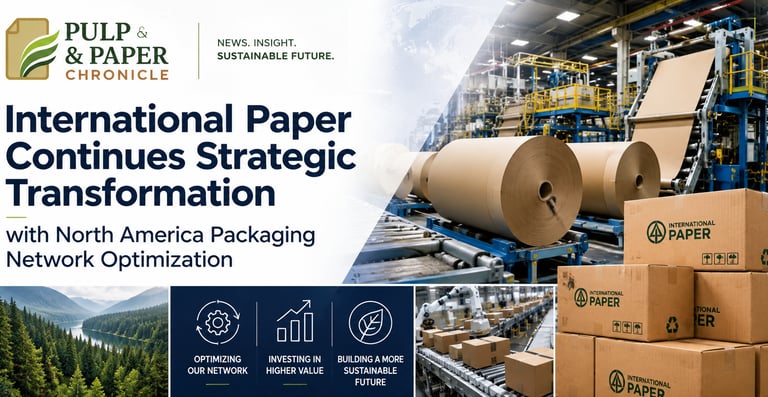
In another significant move that underscores the rapid transformation of the North American packaging industry, International Paper has announced a new phase of its network optimization strategy. The company will cease preprint operations at its Richwood, Kentucky facility and permanently close its sheet plant in Aurora, Illinois, along with converting plants in Elk Grove, California, and Barrington, New Jersey by the end of the third quarter of 2026.
While the announcement involves difficult decisions affecting employees and local communities, from a strategic business perspective it represents a calculated effort to reshape International Paper into a leaner, more efficient, and higher-margin packaging enterprise.
Beyond Cost Cutting: A Structural Transformation
Many investors may initially interpret these closures as simple cost-reduction measures. However, a deeper analysis reveals that this is part of a much broader corporate transformation.
Since expanding its packaging business, International Paper has focused on consolidating production, eliminating underutilized assets, and directing capital toward modern, high-efficiency facilities capable of producing higher-value packaging products.
This strategy is built around three core objectives:
Increasing manufacturing efficiency
Improving return on invested capital (ROIC)
Strengthening long-term competitiveness in sustainable packaging
Rather than maintaining smaller or aging facilities with limited strategic value, the company is concentrating production within its strongest regional manufacturing hubs.
Why Packaging Matters More Than Ever
Global demand for corrugated packaging continues to benefit from several long-term trends:
Continued growth in e-commerce
Expansion of food and beverage packaging
Rising demand for sustainable fiber-based alternatives to plastic
Increasing industrial shipments across North America
Customers today require faster delivery, consistent quality, and greater supply chain reliability.
Maintaining numerous smaller converting facilities often creates higher operating costs, duplicate overhead, and lower asset utilization.
By consolidating operations, International Paper expects to improve production efficiency while serving customers through a more optimized manufacturing footprint.
Reading Between the Lines
The announcement repeatedly emphasizes three themes:
1. Network Optimization
This is not simply plant rationalization.
International Paper is redesigning its entire manufacturing network to maximize throughput while reducing unnecessary complexity.
2. Capacity Reallocation
Production is expected to shift toward larger, more automated facilities capable of producing greater volumes at lower unit costs.
This typically improves:
Operating margins
Manufacturing productivity
Customer service consistency
3. Capital Discipline
Rather than spreading investments across numerous aging facilities, management intends to concentrate future investments where they generate the strongest financial returns.
Investors generally reward this type of disciplined capital allocation.
Financial Implications
Although restructuring expenses will likely affect near-term earnings, the long-term financial outlook appears more favorable.
Potential benefits include:
Lower fixed operating costs
Improved EBITDA margins
Better asset utilization
Stronger free cash flow generation
Higher return on capital employed
For a capital-intensive industry like paper and packaging, even modest improvements in mill utilization and production efficiency can translate into significant earnings gains.
Industry-Wide Trend
International Paper is not acting in isolation.
Across North America, major packaging producers are increasingly optimizing manufacturing networks rather than expanding capacity indiscriminately.
The industry's strategic priorities have shifted from volume growth toward:
Margin expansion
Operational efficiency
Automation
Sustainability
Supply chain resilience
Companies that fail to modernize their production networks risk operating with structurally higher costs in an increasingly competitive market.
Impact on Customers
One notable aspect of the announcement is International Paper's commitment to transitioning customers to nearby facilities.
This indicates that the company does not expect to lose meaningful market share as a result of the closures.
Instead, management appears confident that existing production capacity elsewhere in its network can absorb customer demand while maintaining service levels.
If executed successfully, customers could ultimately benefit from:
More reliable deliveries
Improved product consistency
Faster turnaround times
Greater manufacturing flexibility
Impact on Employees
The most immediate impact will be felt by employees at the affected facilities.
International Paper has stated that it will provide:
Severance packages
Continued benefits
Outplacement assistance
While workforce reductions are never easy, the company is attempting to manage the transition responsibly while preserving long-term business competitiveness.
Market Perspective
From an investor's standpoint, the announcement sends a clear message.
Management is prioritizing profitability over production footprint.
Rather than preserving legacy assets with diminishing strategic value, International Paper is positioning itself for stronger long-term returns by simplifying operations and focusing investments where they create the highest shareholder value.
This disciplined approach aligns with broader trends across the global packaging sector, where operational excellence increasingly determines competitive advantage.
Outlook
The paper and packaging industry is entering a new phase in which scale alone is no longer enough.
Future leaders will be defined by:
Efficient manufacturing networks
Smart capital allocation
Automation
Sustainable packaging innovation
Customer-centric supply chains
International Paper's latest restructuring reflects these realities.
Although the near-term headlines focus on plant closures, the larger story is one of strategic transformation. By optimizing its North American network today, International Paper aims to build a more agile, resilient, and profitable packaging business capable of delivering sustainable growth over the coming decade.
Bottom Line: This announcement should not be viewed merely as a series of facility closures. It represents another deliberate step in International Paper's evolution toward a more efficient, higher-margin, and strategically focused packaging company—one that is positioning itself to compete more effectively in an increasingly demanding global market.