When the global pulp and paper industry moves, we report it first — trusted by 10000 subscribers across 85 countries

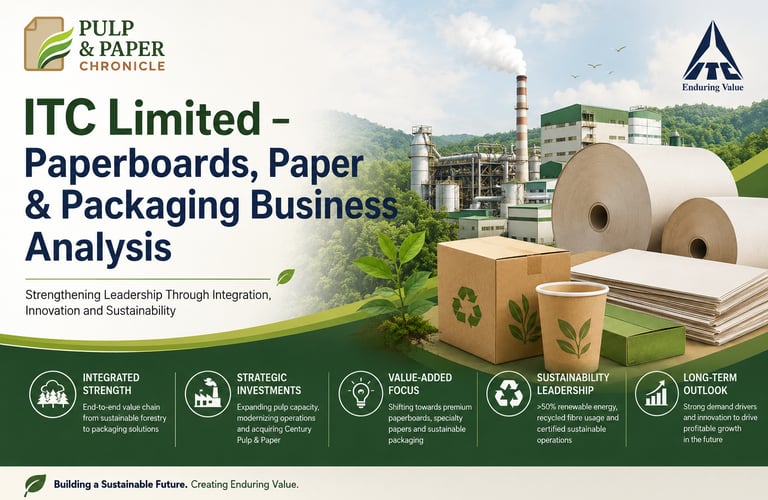
ITC Limited – Paperboards, Paper & Packaging Business Analysis
MARKET ANALYSIS
Jino John
6/29/20265 min read
Executive Summary
The Paperboards, Paper & Packaging (PPP) business remains one of ITC's most strategically important non-cigarette businesses and represents a key pillar of its long-term diversification strategy. Although FY2025–26 was a challenging year due to subdued domestic demand, aggressive imports from China and Indonesia, and elevated wood costs, the business demonstrated resilience through steady revenue growth and continued investment in capacity expansion, sustainability, and technology. Management views the current weakness as cyclical rather than structural and continues to position the business for long-term growth through product premiumization, backward integration, digital manufacturing, and strategic acquisitions. The announced acquisition of Century Pulp & Paper further reinforces ITC's ambition to consolidate its leadership position in India's paper and paperboards industry.
Business Overview
ITC has developed one of the most integrated paper and packaging businesses in India. Unlike many domestic competitors that primarily operate as paper manufacturers, ITC has established a fully integrated value chain beginning from sustainable forestry and plantation development to pulp manufacturing, paperboard production, specialty papers, packaging conversion, printing solutions, and downstream FMCG applications. This integrated model allows the company to exercise greater control over raw material quality, manufacturing efficiency, product innovation, and customer relationships.
The Bhadrachalam facility, India's largest integrated paper plant, serves as the flagship manufacturing complex for the business. Together with facilities at Kovai, Tribeni, and Bollaram, ITC has built a manufacturing network that combines scale with advanced automation and environmental stewardship. The business increasingly focuses on value-added paperboards, specialty papers, food-grade packaging, pharmaceutical packaging, and recyclable fibre-based alternatives to plastics, reflecting changing customer preferences and evolving environmental regulations.
Industry Environment
FY2025–26 proved to be one of the most challenging years for the Indian paper industry in recent times. The market faced significant pressure from low-priced imports originating primarily from China, Indonesia, and Chile. These imports entered the Indian market at prices that domestic manufacturers found difficult to match, resulting in subdued realizations across several paperboard categories. Simultaneously, domestic demand remained relatively weak due to slower consumption across several end-user industries.
Another major headwind during the year was the sharp increase in wood prices. Wood constitutes the single largest raw material input for integrated paper manufacturers, and tight availability significantly increased production costs. The combination of weak selling prices and elevated raw material costs compressed operating margins across the industry.
Despite these challenges, management noted that conditions improved during the second half of the year following the Government of India's decision to impose a Minimum Import Price (MIP) on virgin multilayer paperboards. The reduction in import volumes, combined with strengthening global pulp prices and moderation in wood costs, supported a gradual improvement in pricing and profitability toward the end of the financial year.
Financial Performance
Despite operating in an adverse market environment, the Paperboards, Paper & Packaging segment recorded steady revenue growth during FY2025–26. Standalone external revenue increased to approximately ₹6,927 crore from ₹6,626 crore in the previous year, while total segment revenue, including inter-segment sales, increased to ₹8,766 crore. The increase demonstrates that customer demand for ITC's value-added products remained relatively resilient despite industry-wide pricing pressure.
However, profitability weakened considerably during the year. Segment operating profit declined from ₹911 crore in FY2024–25 to ₹797 crore in FY2025–26, representing a decline of nearly 13%. The reduction was primarily attributable to elevated fibre costs, lower selling prices arising from import competition, and subdued demand conditions. Importantly, the decline does not indicate deterioration in ITC's competitive position but rather reflects the cyclical nature of the paper industry during FY26.
Capital expenditure remained elevated at approximately ₹406 crore, highlighting management's continued confidence in the long-term prospects of the business. Instead of reducing investments during the downturn, ITC continued allocating capital toward modernization, sustainability initiatives, and technology upgrades. This counter-cyclical investment strategy is consistent with management's long-term approach of strengthening competitive advantages during periods of industry weakness.
Strategic Priorities
A defining feature of ITC's paper business is its emphasis on strategic integration rather than volume expansion alone. The company continues investing in pulp import substitution, which aims to reduce dependence on imported pulp while improving supply security and cost competitiveness. Increasing internal pulp production also reduces foreign exchange exposure and provides greater operational flexibility during periods of global supply chain disruptions.
Another major strategic priority is the transition toward value-added paperboards and specialty papers. Rather than competing in commoditized paper grades, ITC increasingly focuses on premium applications including pharmaceutical packaging, food-grade paper, digital print-ready boards, décor papers, and fibre-based sustainable packaging. These products generally command higher margins while being less vulnerable to import competition.
Digital transformation also plays an increasingly important role in the business strategy. ITC continues deploying Industry 4.0 technologies including artificial intelligence, digital twins, predictive maintenance, advanced process automation, and real-time manufacturing analytics. These initiatives are designed to improve productivity, reduce waste, enhance product quality, and lower manufacturing costs over time.
Sustainability as a Competitive Advantage
Sustainability has evolved from a compliance requirement to one of ITC's most significant competitive advantages. The company continues integrating environmental stewardship directly into its manufacturing strategy through renewable energy adoption, sustainable forestry, circular economy initiatives, and resource-efficient operations.
Renewable energy now accounts for more than half of the energy consumed across the paper manufacturing facilities. A notable contributor to this achievement is the commissioning of a state-of-the-art high-pressure recovery boiler at the Bhadrachalam facility, which has significantly reduced coal consumption while lowering carbon emissions.
ITC's forestry programme has cumulatively greened more than 14 lakh acres while simultaneously strengthening rural livelihoods and securing long-term fibre availability. Unlike many global paper manufacturers that depend heavily on market purchases of pulpwood, ITC's social and farm forestry initiatives provide a relatively stable and renewable raw material base. This creates an important structural cost advantage over the long term.
Circular economy practices have also expanded considerably. During FY26, the Kovai unit sourced approximately 93,000 tonnes of waste paper, representing nearly 70% of its total raw material input. This demonstrates the company's increasing reliance on recycled fibre while reducing pressure on virgin fibre resources.
The business has received numerous sustainability recognitions, including GreenCo Platinum+, Alliance for Water Stewardship Platinum certification, and FSC Chain of Custody certification across multiple manufacturing facilities, reinforcing its position as one of the industry's environmental leaders.
Century Pulp & Paper Acquisition
Perhaps the most strategically important development during FY2025–26 was ITC's agreement to acquire the Century Pulp & Paper business from Aditya Birla Real Estate. Management believes that this acquisition will substantially strengthen ITC's competitive position by adding approximately 4.8 lakh tonnes of installed capacity while providing geographic diversification and improved proximity to raw material sources. The acquisition also enhances operational resilience through multi-site manufacturing and creates opportunities for future capacity expansion and economies of scale. From a strategic perspective, the transaction significantly strengthens ITC's leadership position in India's paper industry while complementing its integrated manufacturing model.
Outlook
Despite near-term uncertainty, management remains optimistic regarding the long-term prospects of the Indian paper and paperboards industry. Structural demand drivers—including urbanization, rising disposable incomes, expansion of e-commerce, increasing pharmaceutical production, growth in organized retail, and the substitution of plastic packaging with fibre-based alternatives—are expected to support sustained demand growth over the coming decade. Government emphasis on education is also likely to sustain demand for writing and printing paper.
ITC expects its integrated business model, sustainable fibre sourcing, digital manufacturing capabilities, strong R&D platform, and continued investments in value-added products to enable the company to outperform the broader industry. As cyclical pressures on wood costs and import competition gradually ease, these structural strengths are expected to translate into improved profitability.
Conclusion
The FY2025–26 performance of ITC's Paperboards, Paper & Packaging business should be viewed within the context of an exceptionally difficult industry environment rather than as an indication of structural weakness. Although operating margins were adversely affected by import pressure and elevated raw material costs, the company continued to strengthen its competitive position through sustained investments in technology, sustainability, capacity expansion, and strategic acquisitions. The combination of integrated pulp production, sustainable forestry, premium product development, Industry 4.0 adoption, and the acquisition of Century Pulp & Paper positions ITC to benefit from the expected long-term expansion of India's paper and sustainable packaging markets. As market conditions normalize, the business is well placed to deliver stronger earnings growth while reinforcing ITC's broader strategy of building a diversified, sustainability-led consumer and manufacturing enterprise.