When the global pulp and paper industry moves, we report it first — trusted by 11,000+ subscribers across 85 countries

Longview Disaster: A Wake-Up Call for the Paper Industry
MARKET ANALYSIS
Jino John
6/4/20265 min read
Executive Summary
The pulp and paper industry has always operated at the intersection of heavy engineering, chemical processing, environmental stewardship, and community responsibility. However, the recent catastrophe at the Nippon Dynawave Packaging pulp and paper facility in Longview, Washington, has exposed the devastating consequences that can occur when hazardous process systems fail.
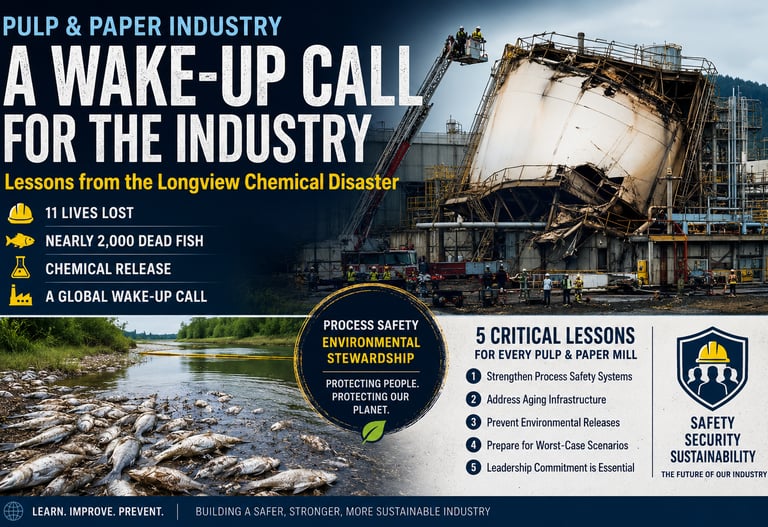
What began as a chemical tank implosion rapidly evolved into one of the deadliest industrial accidents in modern Washington state history. The incident ultimately claimed 11 lives, injured multiple workers, released large quantities of caustic process chemicals, and triggered environmental damage that has resulted in nearly 2,000 dead fish being discovered in nearby waterways.
Beyond the tragic loss of life, the disaster raises urgent questions for pulp and paper manufacturers worldwide:
Are aging chemical storage systems being adequately inspected?
Is process safety receiving the same attention as production efficiency?
Have environmental risk assessments kept pace with operational complexity?
Are mills sufficiently prepared for low-frequency, high-consequence events?
The answers to these questions may determine the future safety reputation of the global pulp and paper industry.
Understanding What Happened
On May 26, 2026, a massive chemical storage vessel containing "white liquor" suffered a catastrophic implosion at the Longview pulp and paper facility operated by Nippon Dynawave Packaging. The tank reportedly contained hundreds of thousands of gallons of the highly caustic pulping chemical used in the kraft process.
White liquor is one of the most critical chemicals used in kraft pulp production. It primarily consists of:
Sodium hydroxide (NaOH)
Sodium sulfide (Na₂S)
These chemicals are essential for separating lignin from wood fibers during pulping. However, they also represent a major process hazard due to their corrosive nature and potential environmental impact when released.
Initial reports confirmed fatalities and multiple missing workers. Over the following days, recovery operations became increasingly complex due to chemical hazards, unstable structures, and ongoing contamination concerns. Eventually, authorities confirmed that all 11 missing workers had died, making the incident one of the worst industrial disasters in recent state history.
The Human Cost: More Than Statistics
Industrial accidents are often reduced to numbers.
11 fatalities.
Several injuries.
One failed tank.
But behind those statistics were electricians, operators, maintenance personnel, supervisors, fathers, sons, brothers, and community members.
Among the victims were two brothers working at the facility, highlighting how deeply industrial tragedies can affect families and entire communities. The Longview region has longstanding ties to forestry, pulp, and paper manufacturing, making the disaster particularly devastating for local residents.
For many industry veterans, the incident has become a painful reminder that process safety is ultimately about protecting people—not equipment.
Environmental Impact: The Growing Fish Mortality Crisis
While attention initially focused on the loss of life, environmental consequences soon emerged.
Chemical releases reached nearby drainage systems and waterways connected to the Columbia River ecosystem. Authorities reported elevated pH levels in affected areas and initiated extensive dilution and mitigation efforts.
The most visible environmental consequence has been aquatic mortality.
Early reports documented only a handful of dead fish. Within days, that number expanded dramatically:
Initial recoveries involved several dozen fish.
Counts later rose into the hundreds.
By the weekend, nearly 2,000 dead fish had been identified in ditches and sloughs surrounding the facility.
Environmental responders stressed that drinking water remained safe and no widespread fish kills were observed directly within the Columbia River itself. Nevertheless, the rapid increase in aquatic mortality illustrates how even short-duration chemical releases can have severe ecological consequences.
Why White Liquor Is So Dangerous
From an industry perspective, white liquor is both indispensable and hazardous.
In normal operations it is:
✓ Controlled
✓ Contained
✓ Recovered
✓ Recycled
When containment fails, however, white liquor becomes a serious threat.
Potential impacts include:
Human Exposure
Severe chemical burns
Eye injuries
Respiratory irritation
Long-term tissue damage
Environmental Exposure
Sudden pH spikes
Fish mortality
Damage to aquatic habitats
Impacts on microorganisms essential for ecosystem health
Infrastructure Damage
Corrosion
Structural weakening
Equipment contamination
The Longview incident demonstrates how rapidly these hazards can escalate when large-volume storage systems fail.
The Industry's Hidden Risk: Aging Infrastructure
Many North American pulp and paper mills were built decades ago.
While production systems have often been modernized, critical storage tanks, piping networks, foundations, and structural components may remain significantly older.
Industry experts increasingly identify three major vulnerabilities:
1. Deferred Maintenance
Competitive pressures can encourage postponement of non-production maintenance activities.
Small defects may remain unnoticed until they become major failures.
2. Corrosion Under Insulation (CUI)
One of the most difficult industrial threats to detect.
Corrosion can develop beneath protective coverings while remaining invisible during routine inspections.
3. Mechanical Integrity Gaps
Storage tanks handling aggressive chemicals require rigorous inspection programs, including:
Thickness monitoring
Structural analysis
Risk-based inspection
Non-destructive testing
A breakdown in any of these areas can increase failure risk dramatically.
Process Safety Versus Occupational Safety
The Longview tragedy highlights an important distinction often misunderstood outside heavy industry.
Occupational Safety
Focuses on:
Slips
Trips
Falls
PPE compliance
Ergonomics
Process Safety
Focuses on preventing catastrophic events involving:
Chemicals
Pressure systems
Tanks
Reactors
Boilers
Energy release
A facility may report excellent occupational safety metrics while still carrying significant process safety vulnerabilities.
The most catastrophic industrial accidents in history—from refinery explosions to chemical releases—typically stem from process safety failures rather than routine workplace hazards.
What Investigators Will Likely Examine
Federal and state investigations are expected to focus on several critical areas:
Tank Design
Was the vessel operating within design limits?
Were modifications made over its lifetime?
Inspection Records
Were inspections completed on schedule?
Were deficiencies addressed?
Process Conditions
Pressure fluctuations
Temperature variations
Chemical concentration changes
Maintenance Activities
Recent repairs
Contractor work
Shutdown/startup operations
Emergency Response
Alarm systems
Evacuation procedures
Hazard communication
Investigators from multiple agencies are already involved in determining root causes.
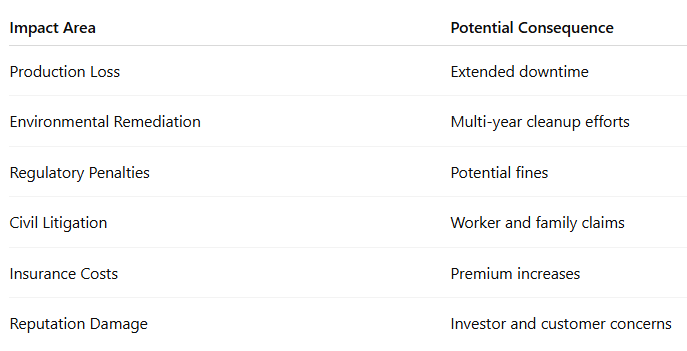
Financial Consequences Could Reach Hundreds of Millions
Major industrial incidents rarely end with cleanup costs alone.
Potential financial impacts include:
For a large integrated pulp and paper operation, prolonged disruption can affect entire supply chains.
A Global Wake-Up Call for the Paper Industry
The Longview disaster should not be viewed as a local event.
It should be viewed as a global warning.
Pulp and paper mills around the world operate:
Recovery boilers
Caustic chemical systems
High-pressure steam networks
Large storage vessels
Hazardous process equipment
Every facility handling white liquor, black liquor, chlorine dioxide, sulfur compounds, or other process chemicals should be reevaluating risk controls in light of this incident.
Industry leaders have spent years advancing sustainability, decarbonization, fiber efficiency, and circular economy initiatives.
Now, process safety must receive equal attention.
Five Critical Lessons for Every Pulp & Paper Mill
1. Safety Culture Must Extend Beyond Compliance
Meeting regulatory requirements is not enough.
Organizations must actively identify emerging risks.
2. Aging Assets Need Renewed Attention
Many facilities require comprehensive structural reassessments.
3. Environmental Protection Starts Inside the Fence Line
Preventing releases remains the most effective environmental strategy.
4. Emergency Planning Must Assume Worst-Case Scenarios
Low-probability events can still occur.
5. Process Safety Is a Leadership Responsibility
Catastrophic incidents are rarely caused by a single failure.
They typically result from multiple weaknesses aligning simultaneously.
Conclusion
The Longview chemical tank disaster will be remembered not only for the tragic loss of 11 workers but also for the environmental consequences that followed, including the discovery of nearly 2,000 dead fish in nearby waterways.
For the global pulp and paper industry, this event represents a defining moment.
The sector has an opportunity to respond with stronger process safety programs, deeper asset integrity management, enhanced environmental safeguards, and renewed commitment to protecting workers and surrounding communities.
The real legacy of Longview should not be measured by the scale of the disaster.
It should be measured by whether the industry learns enough from it to prevent the next one.