When the global pulp and paper industry moves, we report it first — trusted by 11,000+ subscribers across 85 countries

PULP & PAPER CHRONICLE GLOBAL PULP, PAPER & PACKAGING INDUSTRY INTELLIGENCE REPORT MAY 2026 MONTHLY REVIEW
MARKET ANALYSIS
Jino John
6/9/20264 min read
Executive Summary
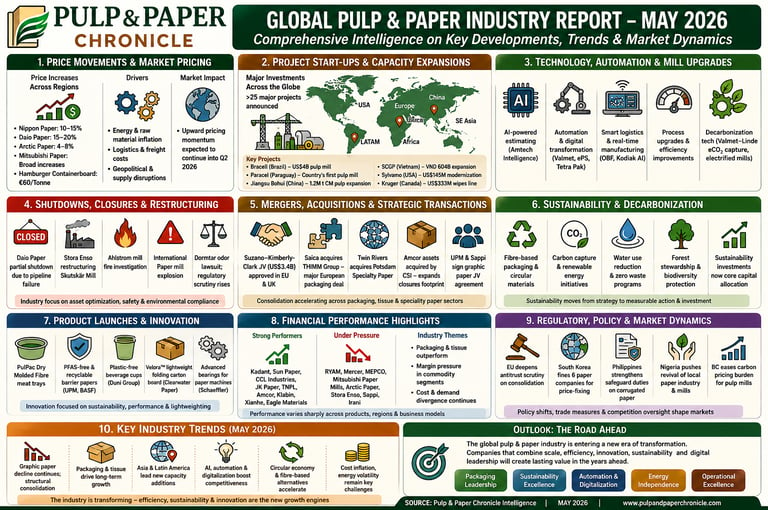
May 2026 marked a pivotal month for the global pulp, paper, packaging and tissue industry as producers accelerated investments in sustainable packaging, digital manufacturing, tissue expansion and strategic consolidation while simultaneously navigating weak demand, rising costs and persistent market oversupply.
More than 100 significant industry developments were recorded during the month across North America, Europe, Latin America, the Middle East and Asia-Pacific.
The month's activity confirms that the industry is entering a new competitive era defined by five dominant forces:
Consolidation and portfolio restructuring.
Expansion of tissue, packaging and specialty paper capacity.
Rapid adoption of AI, automation and digital manufacturing.
Acceleration of sustainability and decarbonization investments.
Increasing pricing actions driven by inflation and supply discipline.
While graphic paper markets continue to contract and restructure, packaging, tissue, fibre-based alternatives and specialty grades remain the primary destinations for global capital investment.
THE FIVE DEFINING INDUSTRY TRENDS OF MAY 2026
1. Global Consolidation Accelerates
The most significant transaction of the month remained Suzano's US$3.4 billion acquisition of a controlling stake in Kimberly-Clark's international tissue business.
The transaction covers 22 manufacturing sites across Europe, Asia, Africa, Oceania, South America and the Middle East, creating one of the world's largest tissue platforms.
Other major consolidation developments included:
• Saica Group's acquisition of THIMM Group.
• Twin Rivers Paper acquisition of Potsdam Specialty Paper.
• Closure Systems International acquisition of two Amcor manufacturing facilities.
• Veritiv acquisition of Quick Pak and Stickel Packaging Supply.
• Fosber acquisition of Quantum Corrugated.
• TRG Packaging acquisition of Columbia Container.
• UPM and Sappi signing a landmark Graphic Paper Joint Venture agreement.
• Essity launching a strategic review of its consumer tissue operations.
Industry Implication:
The sector continues moving toward fewer but larger players capable of supporting sustainability investments, digitalization and regional supply-chain resilience.
2. Packaging Remains the Industry's Growth Engine
Packaging continued to attract the largest share of industry investment.
Major projects announced during May included:
DS Smith – €14 million Romanian modernization project.
SCGP Vietnam – VND 604 billion expansion project.
Hongxiang Paper – 300,000-ton recycled packaging upgrade.
International Paper – New Brandon packaging facility.
Liancheng Heavy-Duty Corrugated Box Project.
ChelnyUpak – Seven-layer corrugated startup.
N R Agarwal – Dahej multilayer board expansion to 1,500 TPD.
Industry Implication:
Packaging remains the strongest performing segment globally as brand owners continue replacing plastic packaging with recyclable fibre-based alternatives.
3. Tissue Expansion Continues Worldwide
The tissue sector remained one of the most active investment categories.
Major developments included:
TNPL entering tissue production and launching LUMEA.
Metsä Group opening one of the world's most advanced tissue mills in Sweden.
Georgia-Pacific advancing premium tissue capacity expansion.
Kruger investing US$333 million in Canada's first Wetlace hybrid wipes line.
Navigator expanding tissue cooperation with Procter & Gamble.
Jani Sales PM3 expansion adding 82,000 tonnes annually.
Suparma Group ordering a new ANDRITZ tissue production line.
Industry Implication:
Population growth, hygiene awareness and premium tissue demand continue supporting long-term tissue market expansion.
4. Sustainability Moves from Strategy to Capital Allocation
Sustainability was no longer a communications initiative during May—it became a primary driver of capital investment.
Major sustainability developments included:
Smurfit Westrock launching Better Planet sustainability targets.
UPM and BASF recyclable barrier paper collaboration.
PulPac expanding Dry Molded Fibre technology.
Duni launching plastic-free beverage cups.
WEPA–Honext circular fibreboard initiative.
Valmet and Linde electrified carbon capture technology.
Kimberly-Clark hydrogen energy project.
Mercer, Mondi, Metsä Board and Oji Holdings accelerating low-carbon initiatives.
Industry Implication:
Companies increasingly allocate capital toward emissions reduction, renewable energy, circular materials and fibre-based plastic replacement technologies.
5. AI & Smart Manufacturing Become Competitive Necessities
May demonstrated a significant shift toward digital manufacturing.
Key developments included:
Amtech Intelligence AI platform launch.
Clarico Systems acquisition.
ePS CommandCore rollout.
Tetra Pak Advanced Agreements recognition.
Valmet Industrial NEXUS ecosystem.
United Paper Mills digital logistics platform.
Kodiak AI autonomous timber transportation.
Graphic Packaging AI-enabled operational optimization.
Industry Implication:
AI is rapidly evolving from a pilot technology into a core operational requirement for cost competitiveness and efficiency.
FINANCIAL PERFORMANCE REVIEW
Strong Performers
Kadant
Revenue +18%
Record bookings of US$320.8 million.
Sun Paper
Double-digit revenue and profit growth.
CCL Industries
Record first-quarter sales and earnings.
JK Paper
Revenue +16.4%
Profit +20.7%.
TNPL
Record FY2026 revenue and sales volumes.
Amcor
Strong earnings supported by Berry acquisition synergies.
Companies Facing Pressure
RYAM
US$81 million quarterly loss.
Mercer International
Lower EBITDA amid weak pulp markets.
Mitsubishi Paper Mills
Significant profit decline.
MEPCO
Net loss reported.
Arctic Paper
Profitability pressure from inflation.
Stora Enso
Weak earnings and Oulu ramp-up costs.
Industry Conclusion:
Profitability remains highly dependent on product mix, with packaging and specialty grades outperforming commodity paper and pulp segments.
CAPACITY EXPANSION & NEW PROJECTS
Major Projects Announced
Bracell
US$4 billion pulp mill financing progression.
Arauco Sucuriú
Major construction milestones achieved.
Paracel
Infrastructure construction begins for Paraguay's first pulp mill.
Jiangsu Bohui
1.2 million-ton chemimechanical pulp expansion.
Yunnan Forestry & Paper
760,000-ton low-carbon pulp project.
Shanying
706,000-ton chemical pulp expansion.
ZhCPK
Modernization and automation investment.
Sylvamo
US$145 million modernization project.
Seshasayee Paper
Copier paper expansion investment.
PRICE MOVEMENTS
Price increases accelerated throughout May.
Nippon Paper
10–15% increases.
Daio Paper
15–20% increases across selected grades.
Arctic Paper
4–8% increase in Europe.
Mitsubishi Paper
Broad price increases announced.
Hamburger Containerboard
€60/tonne increase.
Nine Dragons Paper
Price increases across all manufacturing bases.
Market Assessment:
Persistent inflation, logistics costs and supply discipline continue supporting upward pricing momentum globally.
SHUTDOWNS, RESTRUCTURING & OPERATIONAL EVENTS
Notable developments included:
Daio Paper partial shutdown following wastewater pipeline failure.
Stora Enso restructuring at Skutskär Mill.
SNCPA restructuring program in Tunisia.
Vida AB closure of two Swedish sawmills.
Domtar Crofton mill attracting redevelopment interest.
Smurfit Westrock railcar fire incident.
Ahlstrom mill fire investigation.
International Paper mill explosion.
Washington mill tank implosion incident.
The industry continues rationalizing older assets while concentrating investment in modern, highly automated facilities.
STRATEGIC OUTLOOK FOR THE REMAINDER OF 2026
The global pulp and paper industry is entering a period characterized by:
• Continued consolidation.
• Rising tissue investments.
• Strong packaging demand.
• Increasing sustainability-related capital spending.
• AI-driven operational transformation.
• Capacity growth concentrated in Asia and Latin America.
• Ongoing restructuring in graphic paper grades.
The strongest investment themes for the remainder of 2026 are expected to be:
Sustainable packaging.
Tissue and hygiene products.
Recycled fibre infrastructure.
Smart manufacturing and AI.
Decarbonization technologies.
Fibre-based alternatives to plastic.
Editorial Conclusion
May 2026 will likely be remembered as a month when the industry's transformation accelerated significantly. While short-term challenges such as weak demand, margin pressure and inflation remain, producers are investing aggressively in sustainability, automation, packaging, tissue and next-generation fibre technologies. The companies that successfully combine operational efficiency, digital manufacturing and sustainable product portfolios are expected to emerge as the long-term winners of the next phase of industry evolution.