When the global pulp and paper industry moves, we report it first — trusted by 10000 subscribers across 85 countries
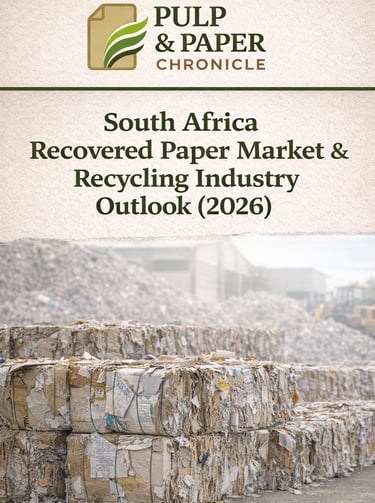
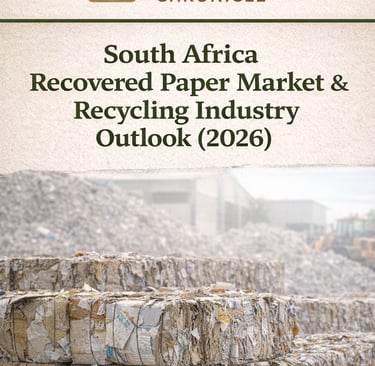
South Africa Recovered Paper Market & Recycling Industry Outlook (2026)
MARKET ANALYSIS
Jino John
4/4/20267 min read
Executive Summary
South Africa’s recovered paper market has entered a phase of structural maturity, characterized by relatively high recovery rates, stable domestic demand for recycled fiber, and increasing policy support for circular economy practices. In 2025, the national paper recycling rate reached 63.3%, reflecting steady progress from approximately 60% in 2024 and positioning the country among the leading recycling performers in emerging markets [PAMSA, industry sources].
Recovered paper volumes are estimated at approximately 1.1–1.2 million tonnes annually, with the majority of material flowing into packaging applications such as containerboard and cartonboard. This reflects the dominance of corrugated packaging in the recovery stream, driven by retail, FMCG, and increasingly e-commerce distribution channels.
Looking ahead to 2026, the market is expected to experience moderate, demand-led growth, although expansion will be constrained less by collection capacity and more by the quality of recovered fiber, particularly contamination and inefficient source segregation. The strategic focus across the value chain is therefore shifting from increasing collection volumes to improving sorting, processing efficiency, and fiber yield.
Market Definition & Segmentation
The recovered paper market in South Africa encompasses the collection, aggregation, sorting, and processing of post-consumer and post-industrial paper and board for reuse in paper and packaging production. It forms a critical component of the broader paper and pulp value chain, linking waste management systems with industrial fiber demand.
From a product standpoint, the market is dominated by Old Corrugated Containers (OCC), which represent the largest and most valuable recovered grade due to their widespread use in transport packaging and their suitability for recycling into containerboard. Mixed paper grades, including household paper waste and lower-quality packaging materials, form a secondary segment but often suffer from contamination issues that limit their usability.
Higher-grade recovered paper, such as office paper and deinking grades, represents a smaller share of the market due to declining consumption of printing and writing paper. However, these grades remain important for specific applications, particularly in tissue production and certain specialty papers.
End-use segmentation is heavily skewed toward packaging applications, including linerboard and fluting for corrugated boxes, followed by cartonboard used in consumer packaging. Tissue and hygiene products also represent a stable and essential outlet for recycled fiber, while demand from newsprint and printing paper segments continues to decline in line with global digitalization trends.
Market Size & Growth
Historically, South Africa’s recovered paper market has demonstrated steady but unspectacular growth. Between 2018 and 2023, recycling rates fluctuated within a relatively narrow band of approximately 55% to 60%, reflecting both structural strengths—such as an established collection network—and persistent challenges, including infrastructure gaps and contamination.
The COVID-19 pandemic introduced short-term disruptions in 2020, particularly in collection activities due to mobility restrictions. However, these impacts were offset by a surge in demand for packaging materials linked to e-commerce and essential goods distribution. As a result, recovery volumes rebounded بسرعة in 2021 and stabilized in subsequent years.
The period from 2024 to 2025 marked a notable improvement phase, with recycling rates increasing to 63.3% and total recovered volumes reaching approximately 1.2 million tonnes annually. Over the past decade, cumulative recovered paper volumes have exceeded 13 million tonnes, underscoring the long-term resilience of the system.
Looking forward to 2026 and beyond, growth is expected to continue at a low single-digit pace. However, reliable public data on precise CAGR projections remains limited. Importantly, future growth will depend less on increasing collection volumes—which are already relatively high—and more on improving the efficiency and quality of recovered material streams.
Demand Drivers & End-Use Sectors
The primary driver of recovered paper demand in South Africa is the packaging sector, which has expanded steadily due to urbanization, retail growth, and changing consumption patterns. Corrugated packaging, in particular, plays a central role in logistics and distribution, ensuring consistent demand for recycled fiber inputs.
E-commerce has emerged as an increasingly important demand driver, mirroring global trends. Even though South Africa’s e-commerce penetration remains lower than in developed markets, it is growing rapidly, contributing to higher consumption of corrugated boxes and protective paper packaging.
In addition, the FMCG sector provides a stable and high-volume source of demand for paper-based packaging. The continuous turnover of packaged goods ensures a steady flow of both virgin and recycled fiber through the system, reinforcing the circularity of the value chain.
Consumer preferences are also shifting in favor of paper-based packaging, driven by environmental concerns and increasing awareness of plastic pollution. Surveys indicate that a majority of consumers prefer paper packaging for online deliveries and favor minimal or right-sized packaging formats. This behavioral shift supports long-term demand for recyclable fiber-based materials.
Finally, the tissue and hygiene segment represents a relatively stable demand base, less sensitive to economic cycles. Recovered fiber is widely used in tissue production, particularly for lower-cost product lines, ensuring consistent baseline demand for recycled paper.
Supply-Side & Capacity Dynamics
On the supply side, South Africa’s recovered paper market is distinguished by its reliance on an extensive informal collection network, which plays a critical role in achieving high recovery rates. Waste pickers, small aggregators, and independent collectors form the backbone of the system, recovering significant volumes of paper before it reaches landfill.
This decentralized model offers both advantages and challenges. On one hand, it enables high collection efficiency at relatively low cost. On the other hand, it introduces variability in material quality and limits the scalability of formalized recycling systems.
The downstream processing and manufacturing segment is more consolidated, with major players such as Sappi Limited, Mondi Group, and Mpact Limited operating integrated business models that include recycling, paper production, and packaging conversion.
In terms of capacity, the market has not seen significant greenfield pulp or paper mill investments in recent years. Instead, capital expenditure has focused on incremental efficiency improvements, including upgrades to sorting facilities, recycling plants, and packaging production lines. This reflects a broader industry trend toward optimizing existing assets rather than expanding capacity aggressively.
Regional Breakdown
Within Africa, South Africa stands out as one of the most advanced markets for paper recycling, both in terms of recovery rates and industrial utilization of recovered fiber. The country’s relatively developed infrastructure, combined with strong industrial demand, supports a functioning circular economy for paper products.
However, there are significant regional disparities within the country. Urban centers such as Johannesburg, Cape Town, and Durban exhibit higher recovery rates due to better access to collection networks and higher consumption of packaged goods. In contrast, rural areas face challenges related to infrastructure, logistics, and awareness, resulting in lower recovery rates and higher levels of waste leakage.
Trade & Supply Chain
South Africa’s recovered paper market is largely domestically oriented, with most collected material being processed and consumed within the country. This reduces exposure to global recovered paper trade volatility but also limits opportunities for export-driven growth.
Logistics remains a key constraint, particularly given the decentralized nature of the collection system. Transportation costs can be significant, especially for low-value mixed paper grades, which affects the economics of recovery and recycling.
Pricing Trends
Recovered paper prices in South Africa are influenced by a combination of domestic and global factors. Key cost drivers include the price of virgin pulp, energy costs, labor, and logistics. Given the country’s energy challenges, electricity costs and supply reliability are particularly important considerations for recyclers and paper producers.
In recent years, pricing has been volatile, reflecting fluctuations in global pulp markets and local supply-demand dynamics. Periods of strong packaging demand have supported higher prices for OCC, while economic slowdowns have exerted downward pressure.
Looking ahead to 2026, pricing is expected to remain relatively stable with a slight upward bias, supported by steady demand for packaging materials and constraints on the availability of high-quality recovered fiber.
Regulations, Sustainability & ESG
Regulatory developments are playing an increasingly important role in shaping the recovered paper market. South Africa has implemented Extended Producer Responsibility (EPR) regulations, which require producers to take greater responsibility for the lifecycle of their products, including waste management and recycling.
These policies are aligned with broader sustainability goals, including landfill reduction, resource efficiency, and carbon emissions mitigation. Recycling paper offers significant environmental benefits, including reduced energy consumption compared to virgin fiber production and substantial savings in landfill space.
ESG considerations are becoming more prominent across the value chain, with companies focusing on improving recyclability, reducing environmental impact, and enhancing transparency in sourcing and production processes.
Technology & Innovation
Technological innovation in the sector is focused primarily on improving efficiency and material quality. Advanced sorting technologies, including automated and AI-assisted systems, are being explored to reduce contamination and increase recovery rates for usable fiber.
In addition, digital tools for waste tracking and supply chain optimization are gaining traction, enabling better coordination between collectors, processors, and manufacturers. There is also growing interest in integrating informal collectors into formal systems through digital platforms and incentive mechanisms.
Risks & Challenges
Despite its strengths, the South African recovered paper market faces several structural challenges. The most significant of these is contamination, which reduces the usability of recovered paper and limits fiber yield. Poor source segregation at households, businesses, and institutions results in paper being mixed with food waste or exposed to moisture, rendering it unsuitable for recycling.
Dependence on the informal sector, while beneficial for collection efficiency, also introduces risks related to income stability, lack of formal recognition, and limited access to infrastructure and financing.
Infrastructure limitations, particularly in sorting and processing, further constrain the system’s ability to improve quality and efficiency. In addition, ongoing energy supply issues pose operational challenges for recycling facilities and paper mills.
2026 Outlook & Scenarios
In the base-case scenario, the market is expected to maintain its current growth trajectory, with recycling rates increasing modestly to approximately 64%–66%. Demand from packaging and tissue sectors will remain stable, while gradual improvements in sorting and awareness may enhance material quality.
In an upside scenario, stronger enforcement of EPR regulations and increased investment in infrastructure could accelerate improvements in recovery efficiency and push recycling rates beyond 67%.
Conversely, in a downside scenario, economic weakness or disruptions in the packaging sector could dampen demand, leading to stagnation in recovery rates and increased pressure on recycling economics.
Conclusion & Strategic Takeaways
South Africa’s recovered paper market is transitioning into a more advanced stage of development, where incremental gains will depend on efficiency improvements rather than expansion of collection volumes.
The market has achieved relatively high recovery rates by emerging market standards
Future growth will be quality-driven, not volume-driven
Packaging demand will remain the core structural driver
Integration and formalization of the informal sector is critical
Investment in sorting and processing infrastructure is a priority
Regulatory frameworks, particularly EPR, will shape industry dynamics
Energy and logistics constraints remain key operational risks
📌 Final Insight
The industry is moving toward a “second-stage circular economy model”, where optimizing fiber quality, improving system integration, and enhancing economic efficiency will determine long-term competitiveness. Stakeholders that invest early in these areas are likely to capture disproportionate value as the market evolves through 2026 and beyond.