When the global pulp and paper industry moves, we report it first — trusted by 10000 subscribers across 85 countries

Voith Delivers 3,000th Headbox, Marking Major Milestone in Papermaking Technology
PAPER INDUSTRY NEWS
Jino John
3/25/20261 min read
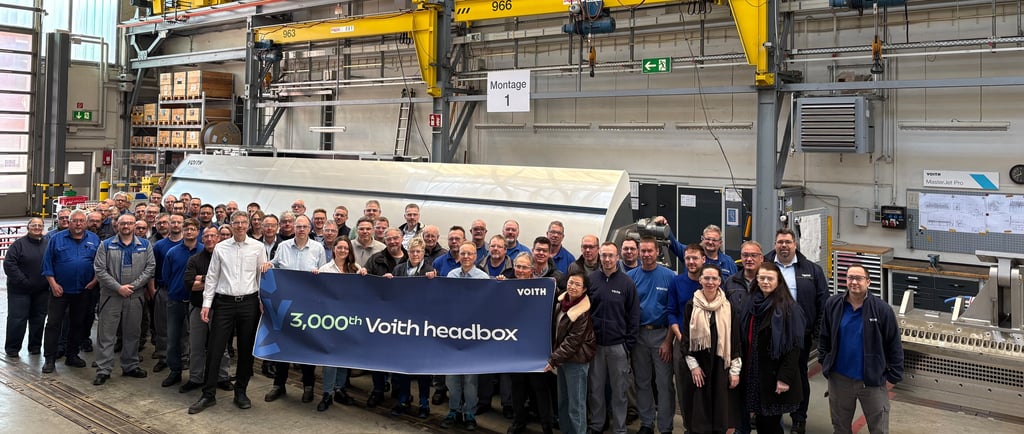
Voith has reached an important milestone with the delivery of its 3,000th headbox. Since the first Voith headbox was supplied in 1914, the company has continuously improved one of the most critical components of the paper machine. Today, Voith headboxes are installed in paper mills around the world and form the technological basis for stable production, consistent quality and high operational efficiency.
Headboxes play a central role in papermaking. Their primary task is to ensure uniform basis‑weight profiles across paper webs that can reach widths of up to ten meters. At the same time, they are essential for achieving good formation, enabling a homogeneous fiber distribution in the sheet. Modern headboxes must also meet growing requirements in terms of efficiency, low maintenance effort, reduced cleaning intervals and increasingly lower energy consumption. The integration into automation systems has therefore become a decisive factor, particularly with advanced control solutions such as dilution water profiling.
The 3,000th Voith headbox is part of a complete paper machine order for a Chinese customer. The delivery includes two MasterJet 4Tec F headboxes, marking the first application of the MasterJet 4Tec F series. Until now, the MasterJet 4Tec technology had been available only for smaller width headboxes. The F‑version is designed for large paper machines, supporting web widths of up to 11.6 meters and operating speeds of up to 1,600 meters per minute.
With MasterJet 4Tec, Voith has further refined headbox performance by combining proven mechanical design with completely new elements. The ModuleJet dilution control system enables precise cross‑direction basis‑weight control, supporting stable profiles and high reproducibility. These features contribute to improved product quality, reduced raw material consumption and more efficient operation throughout the life cycle of the paper machine.